



Adding Video Call Guests to Your Live Production

By Dacast Editorial Team | Reviewed by Jon Whitehead, COO at Dacast | Updated September 2026
Bringing a remote guest into your live stream means capturing their video call feed, whether from Zoom, a browser call, or dedicated production software, as a source inside your broadcast, then sending the combined output to your streaming platform. As of 2026, this is far easier than it used to be: Skype and Google Hangouts, the two tools most guides (including this one, previously) built this workaround around, have both been shut down, and most production software now has guest calling built in natively.
In this guide, we’ll walk through the two paths for bringing a remote guest into your stream: the quick native route (streaming directly from a video call platform like Zoom, covered in our Zoom live streaming walkthrough), and the production route using Wirecast, OBS Studio, or vMix for a multi-source, multi-guest show. Then we’ll cover how to get that finished feed onto Dacast for delivery and monetization.
TL;DR:
- Bringing a remote guest into a live broadcast means capturing their video call feed as a source inside your production software, then sending the combined output to your streaming platform.
- For a single guest with minimal setup, Dacast’s native Zoom integration streams a Zoom call directly, no separate production software required.
- For multi-camera productions with graphics or multiple guests, use dedicated software: Wirecast’s built-in Rendezvous, vMix’s built-in vMix Call, or OBS Studio paired with the free browser-based VDO.Ninja.
- Skype and Google Hangouts, the two examples this guide previously relied on, were both shut down (Skype in May 2025, Hangouts in 2022); any workflow built around either no longer works.
- Whatever software you produce with, push the final output to Dacast over RTMP, SRT, or WHIP for delivery and monetization.
Table of Contents
- Live Streaming vs. Video Conferencing: A Quick Distinction
- Two Ways to Bring a Guest Into Your Live Stream
- Wirecast + Rendez-vous
- OBS Studio + VDO Ninja
- vMix Call
- Sending Your Production to Dacast
- Quick comparison
- FAQ
- Conclusion
Live Streaming vs. Video Conferencing: A Quick Distinction
Video conferencing is two-way: every participant sends and receives video. Live streaming is one-way: video flows from the broadcaster to the audience. (For a deeper look at planning a livestreamed conference or meeting, see our guide on live streaming conferences and virtual meetings.)
Bringing a video call into a live stream blends the two: one or more participants join via video conferencing software, and their feed becomes a source inside a one-way broadcast. It’s a great way to add an interactive, multi-guest feel to an otherwise one-way production.
Two Ways to Bring a Guest Into Your Live Stream
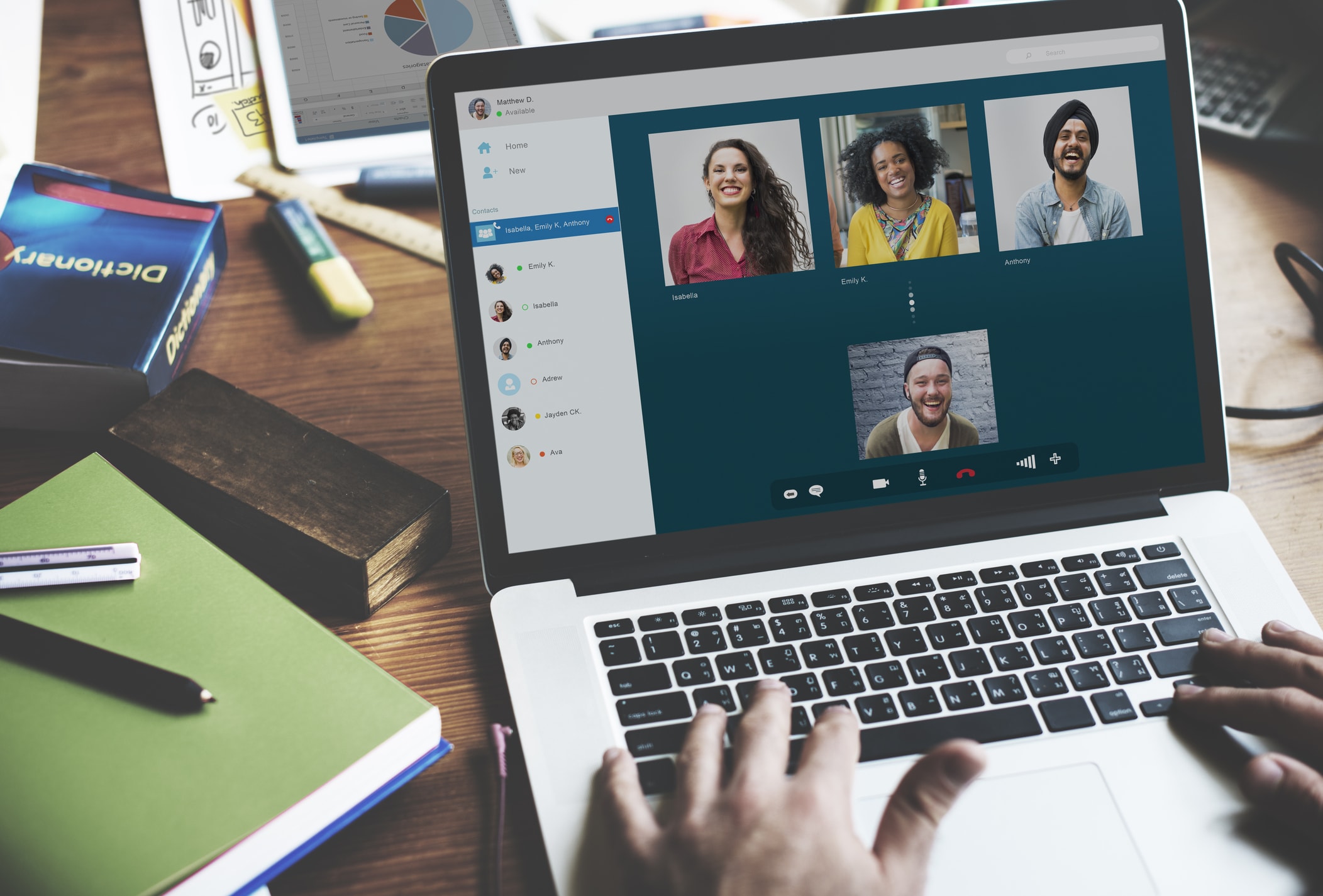
There are two practical approaches, depending on how simple or how produced your show needs to be.
Path 1, the quick route: if you’re running a single-guest interview with no additional cameras or graphics, Dacast’s native Zoom integration lets you stream a Zoom call directly to your channel. See our Zoom live streaming walkthrough for the full setup.
Path 2, the production route: if you want a multi-camera show, lower thirds, a host desk alongside the guest, or more than one remote participant, you’ll need dedicated production software. Wirecast, OBS Studio, and vMix each have a way to bring a guest’s video call into your program feed, covered below.
Wirecast + Video Chat
Wirecast has built video calling into the software since version 14: it’s called Rendezvous. Instead of capturing a third-party video call app’s window (the old workaround above), Rendezvous runs the call itself and hands you the guest’s feed as a native shot.
- In Wirecast, open the Rendezvous panel and generate a private call-in link for your guest.
- Send the guest that link; they join from a browser, no separate video call app needed.
- Add the guest’s Rendezvous feed as a shot in your production, alongside your other cameras and sources.
- Audio is routed automatically, since the call runs inside Wirecast rather than being captured from a separate app’s window.
- Send your guest a return feed of the program output if you want them to see what’s being broadcast.
This replaces the entire desktop-capture workaround that used to be necessary with Skype or similar apps: no virtual camera setup, no manual audio source matching, no risk of capturing the wrong window.
OBS Studio + Video Chat
OBS Studio doesn’t have a built-in call feature, but it no longer needs a Mac-specific audio workaround either. VDO.Ninja is a free, browser-based tool built for exactly this: getting a remote guest’s audio and video into a production tool like OBS without capturing a video call app’s window or wrestling with system audio routing.
- Guest opens a VDO.Ninja invite link in their browser and grants camera/microphone access. No account or software install required.
- In OBS, add a Browser Source pointed at your VDO.Ninja room’s output view.
- The guest’s video and audio arrive as a clean source, with no desktop-capture artifacts (notification sounds, cursor movement, other app windows).
- Scale and position the browser source alongside your other cameras and graphics.
Dedicated live stream software for talk shows: integrated video calling in vMix
vMix has had a built-in video call feature, vMix Call, since 2017, and it remains one of the more straightforward ways to bring a guest into a produced live stream. When choosing inputs, select “Video Call” to either call another vMix user or have a guest call in.
Calls run over WebRTC, an open web communication standard. Guests join from a browser (Chrome or Firefox) on a computer or Android device via vmixcall.com, entering a password you provide and their name.
vMix Call also lets you send a return feed to your guest, with its own audio source, video source, and bandwidth setting, so they can see and hear the live program output.
vMix is available in several editions; as of this update, the HD, 4K, and Pro tiers support vMix Call, with HD supporting one caller, 4K supporting two simultaneous callers, and Pro supporting up to eight callers.
Sending Your Production to Dacast
Once your guest is live inside Wirecast, OBS, or vMix, the final step is getting that combined program feed onto Dacast for delivery, recording, and monetization. Dacast accepts RTMP, SRT, and WHIP ingest with adaptive HLS delivery, so whichever production software you used, you point its output at your Dacast stream key and go live.
If you’re using the quick route (streaming a Zoom call directly, no separate production software), Dacast’s native Zoom integration skips this step entirely: the call streams straight to your channel.
Quick comparison
| Method | Setup | Guest capacity | Cost | Best for |
| Dacast native Zoom integration | Easiest, no production software | 1 guest | Included with Dacast plan | Quick single-guest interviews |
| Wirecast Rendezvous | Built into Wirecast | Multiple (edition-dependent) | Included with Wirecast license | Multi-camera pro productions already on Wirecast |
| vMix Call | Built into vMix | 1 (HD) / 2 (4K) / 8 (Pro) | Included with qualifying vMix edition | Multi-guest panel shows |
| OBS + VDO.Ninja | Free browser tool + Browser Source | Multiple (room-dependent) | Free | Budget-conscious, no dedicated license |
FAQ
1. Can I still use Skype to bring a guest into my live stream?
No. Microsoft shut down Skype in May 2025. If your workflow was built around Skype, switch to Wirecast Rendezvous, vMix Call, or OBS with VDO.Ninja instead.
2. What happened to Google Hangouts?
Google retired the consumer version of Hangouts in 2022, replacing it with Google Chat and Google Meet. It’s no longer a viable option for this workflow either.
3. Do I need separate production software to stream a video call guest?
Not always. For a single guest with no extra cameras or graphics, Dacast’s native Zoom integration streams a Zoom call directly. Production software (Wirecast, OBS, vMix) is for multi-source, multi-guest shows.
4. Is VDO.Ninja free?
Yes. VDO.Ninja is a free, browser-based tool guests use with no software install or account required, making it a low-cost alternative to a dedicated video-call integration.
5. How many remote guests can I bring into one live stream?
It depends on your software. vMix supports up to 8 simultaneous callers on its Pro edition; Wirecast Rendezvous and VDO.Ninja guest limits depend on your specific setup and license tier.
6. Where does my finished production feed go once I’ve added a guest?
Whatever software you use, send the combined output to Dacast via RTMP, SRT, or WHIP ingest for delivery, recording, and monetization.
Conclusion
Bringing a remote guest into a live broadcast is far easier today than it was even a few years ago. WebRTC-based tools, whether built into your production software (Wirecast Rendezvous, vMix Call) or free-standing (VDO.Ninja), have eliminated the desktop-capture workarounds this guide used to recommend.
Whichever path you choose, the last step is the same: send your finished production to Dacast for reliable delivery, recording, and monetization.
Finally, if you’re not yet streaming with Dacast, why not sign up for our 14-day free trial (no credit card required)? Just click the button below to create an account with the Dacast online video platform. From there, you can start streaming in a matter of minutes!
