



Hardware Encoders for RTMP, HLS, and SRT: How to Choose the Right Device for Professional Live Streaming
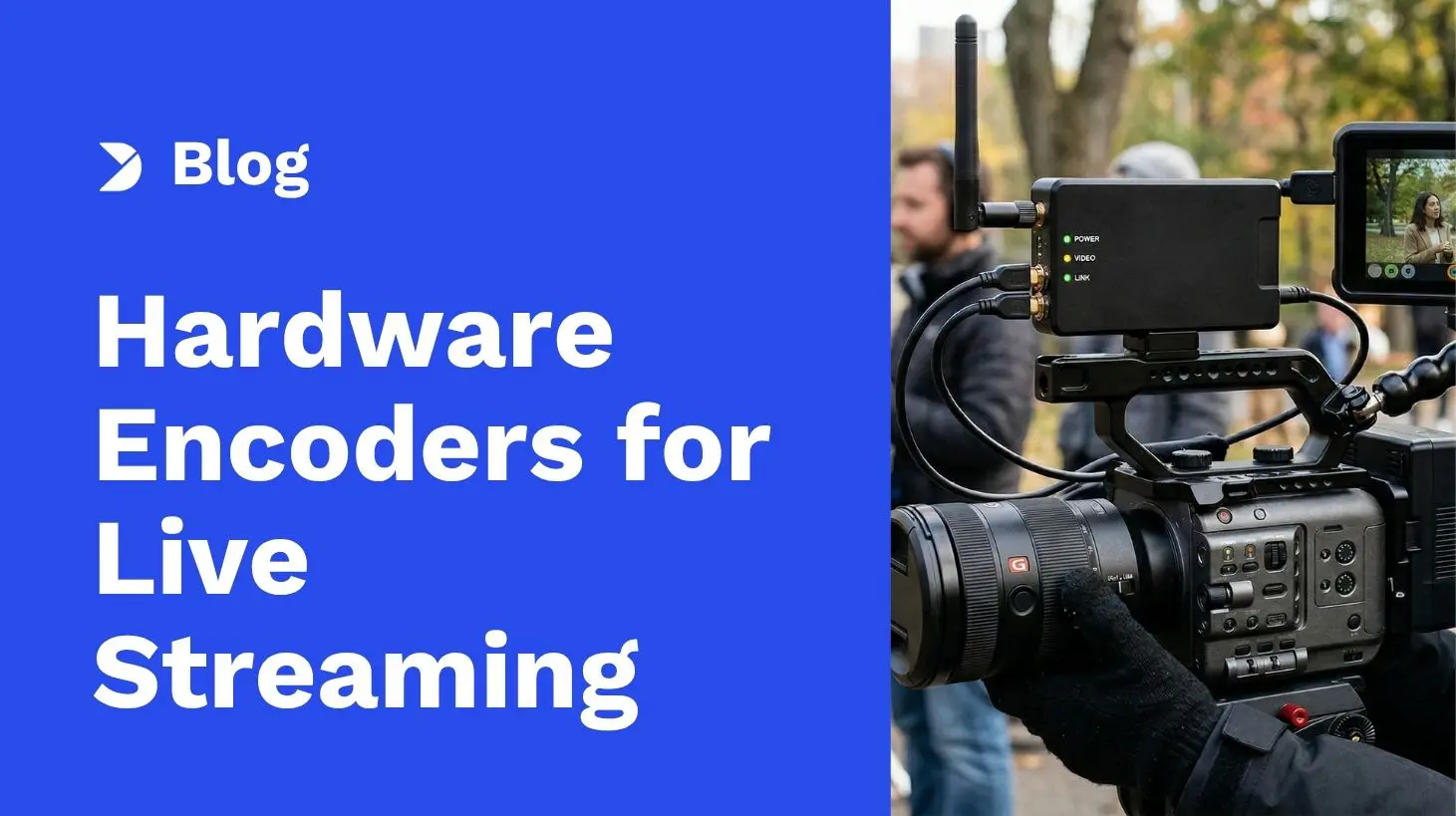
Dacast Editorial Team — reviewed by Dacast’s streaming infrastructure specialists. March 2026
A hardware encoder for live streaming is a dedicated physical device that converts raw camera signals into compressed video streams for real-time transmission over IP networks. Unlike software on a general-purpose computer, hardware encoders use purpose-built components designed for stable, continuous encoding — the standard choice when downtime isn’t an option.
In 2026, you can go live with a laptop and a free app. But if reliability matters, if failure costs money, reputation, or public trust; you need more than that. Protocol choice is where most teams get it wrong. RTMP, SRT, and HLS play different roles in the same workflow, and choosing the right encoder means understanding how they fit together.
This guide breaks down RTMP vs HLS vs SRT in practical terms, walks through a step-by-step buying checklist, and maps recommendations to real-world use cases including sports, enterprise, remote production, and government.
TL;DR
- A hardware encoder converts camera signals into compressed streams for live broadcasting — more stable and reliable than software encoders for mission-critical events.
- Use RTMP for simple ingest from stable, wired venues. Use SRT for remote or unstable networks. HLS handles delivery to viewers — you don’t choose between them, you use them together.
- Before buying, prioritize: protocol support (RTMP + SRT), network resilience, monitoring tools, and redundancy — not just resolution.
- Hardware makes sense when stream failure has real consequences: ticketed events, government sessions, earnings calls, healthcare training.
- Dacast supports both RTMP and SRT ingest, and delivers to viewers via HLS.
Table of Contents
- What Is a Hardware Encoder (and Why It Matters for Live Streaming)?
- RTMP vs HLS vs SRT: What Each Protocol Is Best At
- Hardware Encoder Buying Checklist (RTMP/HLS/SRT Workflows)
- Industry Use Cases: What to Prioritize by Vertical
- Best Practices for Reliable, High-Quality Live Streams
- Integrating Hardware Encoders with Dacast (RTMP, HLS, SRT)
- FAQs
- Conclusion
What Is a Hardware Encoder (and Why It Matters for Live Streaming)?
A hardware encoder is a dedicated device that converts raw video and audio signals into a compressed digital stream suitable for live video broadcasting. Instead of relying on a laptop or workstation, it uses purpose-built processing components designed specifically for encoding and transmitting video over IP networks.
At a high level, it takes this path:
Camera → Hardware Encoder → Streaming Platform/CDN → Video Player
That simple chain powers everything from sports broadcasts to enterprise town halls.
What Goes In
Most professional hardware encoders accept:
- HDMI inputs (common for DSLR, mirrorless, and prosumer cameras)
- SDI inputs (broadcast-grade cameras and long cable runs)
- Embedded or analog audio inputs
- In some cases, NDI or IP-based inputs for network-based production workflows
The encoder captures that signal, compresses it using codecs like H.264 or HEVC, and prepares it for transport using a streaming protocol.
What Comes Out
Depending on the model, hardware encoders can output:
- RTMP (common ingest for many live streaming platforms)
- SRT (secure, low-latency transport over unstable networks)
- RTP or MPEG-TS (often used in broadcast and contribution workflows)
In most modern workflows, you send RTMP or SRT to a streaming and hosting platform, which then distributes content via HLS for playback across devices.
If you’re building professional video streaming solutions, understanding this transport layer matters just as much as understanding resolution or bitrate.
Where the Encoder Sits in a Professional Workflow
Think of the encoder as the bridge between production and distribution.
- Cameras and switchers generate raw video.
- The hardware encoder compresses and packages that signal.
- The live streaming platform ingests it.
- The CDN distributes it globally.
- Viewers watch via an HLS-based player.
If you’re comparing a live streaming platform to a video hosting platform, this is where the difference becomes practical. Live broadcasting depends heavily on encoder reliability. On-demand video hosting begins after recording or post-production. The encoder is mission-critical for live, but it plays no role in uploading pre-produced content.
This distinction becomes even more important when evaluating live streaming vs video hosting for businesses, where uptime, security, and delivery performance directly impact ROI.
Hardware vs Software Encoding
Both approaches can deliver high-quality streams, but they behave very differently under pressure.
Hardware Encoding
Hardware encoders are:
- Purpose-built for streaming
- Designed for 24/7 uptime
- Thermally predictable (no surprise CPU spikes)
- Less vulnerable to OS crashes or background processes
- Often remotely manageable via web dashboards
- Easier to deploy in fixed installations
They introduce operational stability. When you deploy them in government chambers, sports venues, churches, or enterprise boardrooms, they behave like infrastructure, not like a workstation running apps.
In practice, this is what that looks like: a Blackmagic Web Presenter HD connects directly via SDI or HDMI, streams over Ethernet with no computer required, and runs continuously without OS interference. A Haivision Makito X4 takes that further : dual NICs, fleet management, and SRT built in, for environments where downtime isn’t acceptable.
Software Encoding
Software encoders run on laptops or desktops. They offer:
- Lower upfront cost
- Greater flexibility (graphics, scene changes, overlays)
- Rapid experimentation
- Easy updates
But they also introduce variance:
- CPU contention
- Operating system updates
- Driver conflicts
- Thermal throttling
- Higher risk of human error
Software is powerful for content creators and agile teams. But when you’re managing large-scale live video broadcasting or mission-critical enterprise communications, operational predictability matters more than flexibility.
Why Hardware Still Matters in 2026
Cloud workflows are more advanced than ever. AI-assisted encoding, remote production, and edge delivery have improved dramatically. But physical encoders still solve real-world problems:
- Stable uplinks from fixed venues
- Long-duration events (8+ hours)
- Limited on-site technical staff
- Environments where laptops aren’t an appropriate infrastructure
- Secure, controlled IT deployments
- Remote field contribution over bonded cellular
If you’re comparing the difference between live streaming and on-demand video, this is where the live side becomes technically demanding. Hosting video-on-demand (VOD) requires storage and delivery. Live requires real-time encoding, transport, monitoring, and recovery. That real-time pressure is exactly why hardware still has a strong place in professional environments.
Decision Rule: When Hardware Makes Sense
Use this practical rule: if stream failure would cost you money, reputation, legal compliance, or audience trust – invest in hardware.
That applies to:
- Ticketed sports events
- Government meetings
- Corporate earnings calls
- Large-scale conferences
- Faith-based weekly services
- Healthcare training streams
In contrast, if you’re experimenting, producing occasional marketing streams, or working with limited budgets, software may be sufficient.
Common Mistake: Buying Based on Resolution Alone
Many teams buy a 4K live streaming encoder hardware and stop thinking. However, resolution is not the primary decision factor. Before you purchase, evaluate:
- Network stability (wired vs bonded vs public internet)
- Required protocol (RTMP vs SRT)
- Latency tolerance
- Monitoring capabilities
- Remote management
- Redundancy options
- Failover behavior
- Platform compatibility
- Security requirements
A 4K encoder won’t fix packet loss, a high bitrate won’t solve firewall issues, and a powerful chipset won’t replace proper monitoring. When building a professional live streaming workflow, especially if you also plan to turn live streams into on-demand videos for a hybrid strategy, the encoder must align with your broader infrastructure, not just your camera specs.
RTMP vs HLS vs SRT: What Each Protocol Is Best At
If you’re shopping for a hardware encoder for live streaming, protocol support matters as much as resolution or bitrate. The right protocol determines how your video moves from the camera to the platform and from the platform to viewers.
Think in terms of roles – most professional workflows separate contribution (ingest) from delivery (playback): Encoder (SRT or RTMP) → Streaming Platform → HLS to Viewers
You don’t usually choose one protocol for everything. You choose the right one for each stage.
RTMP (Real-Time Messaging Protocol)
Typical role: Ingest from encoder to platform
RTMP remains the most common way to send video from a hardware encoder to a live streaming platform. Nearly every professional streaming and hosting platform supports RTMP ingest, which makes setup straightforward.
Why buyers still choose it:
- Widely supported across encoders and platforms
- Simple configuration (URL + stream key)
- Mature ecosystem and tooling
- Stable for controlled, wired environments
Where it falls short: RTMP is no longer ideal for large-scale viewer playback. Most platforms automatically convert RTMP ingest into HLS or LL-HLS for delivery. It also lacks modern transport resilience compared to SRT when networks become unstable.
However, if your venue has reliable wired internet and you want maximum compatibility, RTMP remains a safe, predictable choice for ingest.
HLS (HTTP Live Streaming)
Typical role: Delivery to viewers
HLS dominates playback. Once your stream reaches the platform, it’s typically repackaged and distributed via HLS to browsers, mobile apps, and smart TVs.
Why buyers choose it:
- Broad device compatibility
- CDN-friendly and highly scalable
- Firewall- and NAT-friendly (runs over HTTP/HTTPS)
- Works well for global audiences
The tradeoff: Standard HLS introduces higher latency compared to real-time transport protocols. A low-latency streaming encoder reduces delay significantly, but actual performance depends on encoder configuration, segment duration, CDN behavior, and player setup.
For most professional live video broadcasting of sports, enterprise town halls, or government meetings, HLS remains the most reliable viewer-facing protocol.
When comparing live video vs recorded video, HLS also plays a role in video-on-demand (VOD). Platforms often use the same HLS-based delivery system for both live streams and on-demand video hosting, which simplifies a hybrid video strategy (live + VOD).
SRT (Secure Reliable Transport)
Typical role: Contribution/ingest over unpredictable networks
SRT excels when network conditions aren’t ideal. Remote production teams, field reporters, sports crews using bonded cellular, and distributed enterprises often rely on a hardware encoder for remote live streaming (SRT) for stable contribution.
Field encoders like the Teradek Prism and LiveU Solo PRO are built specifically for this scenario. Both support SRT over bonded cellular connections and are designed to maintain stable streams from locations where wired internet simply isn’t available. For fixed deployments that still need SRT flexibility, the Kiloview E3 supports RTMP, SRT, and NDI simultaneously and streams to up to 16 destinations at once.
Why buyers choose it:
- Strong resilience to packet loss and jitter
- Adjustable latency buffers
- Built-in encryption options
- Designed for unstable or long-distance networks
The tradeoff: SRT requires more configuration. You must tune latency buffers properly and ensure networking rules align with firewall and NAT requirements. It’s powerful, but not always plug-and-play.
However, if you stream from venues with unreliable uplinks, public internet, or mobile networks, SRT often delivers more consistent results than RTMP.
Protocol Comparison
| Criteria | RTMP | HLS | SRT |
| Typical Role | Ingest (encoder → platform) | Delivery (platform → viewers) | Contribution/Ingest (encoder → platform) |
| Latency Profile | Low (depends on setup) | Medium to higher (LL-HLS reduces latency) | Low to medium (buffer configurable) |
| Reliability on Bad Networks | Moderate | High for delivery | High (designed for packet loss/jitter) |
| Firewall/NAT Friendliness | Moderate | High (HTTP-based) | Moderate (depends on configuration) |
| Security/Encryption Options | Limited natively | HTTPS-based delivery | Built-in encryption support |
| Best-Fit Use Cases | Fixed venues, wired enterprise uplinks, standard platform ingest | Global audience playback, multi-device streaming, large-scale events | Remote production, field contribution, unstable internet, bonded cellular |
Latency always depends on configuration, buffering, encoder settings, and network conditions. No protocol is “always low latency” in every scenario.
Contribution vs Delivery (Practical Flow)
Here’s how modern professional video streaming solutions typically structure the chain:
Camera → Hardware Encoder (RTMP or SRT) → Streaming Platform → HLS → Viewers
You send video to the platform using RTMP or SRT. The platform distributes it to viewers using HLS. This separation explains why many encoders advertise RTMP and SRT support, while viewers rarely hear those terms. Playback relies on HLS.
Buyer Decision Shortcuts
- If your internet is stable and predictable → RTMP ingest usually works well.
- If your network is unstable or remote → prioritize SRT support.
- If you’re delivering to a broad, public audience → HLS remains essential.
When evaluating the difference between live streaming and video hosting, protocols matter most on the live side. On-demand video hosting focuses more on storage, transcoding, and playback performance. Live streaming depends on transport stability in real time. In practice, the best encoder for professional live streaming supports at least RTMP and SRT for ingest, because your network conditions will not always behave the way you expect.
Hardware Encoder Buying Checklist (RTMP/HLS/SRT Workflows)
This is where most buying decisions go wrong. Teams compare resolution specs, pick the most powerful device in budget, and assume it will “just work.” But hardware encoders don’t exist in isolation. They sit inside a larger live video broadcasting system that includes networks, platforms, CDNs, monitoring, and, increasingly, a hybrid video strategy (live + VOD).
Use this checklist to make a decision based on workflow, not marketing.
Step 1: Define Your Workflow
Before you look at models, answer these questions:
Are you streaming from a single venue or multiple remote locations?
A fixed venue with wired fiber behaves very differently from field production over public internet.
Will you stream to one platform or simulcast?
If you plan to send to multiple destinations, you may need multi-destination outputs or a platform that handles redistribution.
Do you need contribution over public internet?
If yes, SRT support becomes far more important than RTMP alone.
What latency do you actually need?
- Interactive (Q&A, betting, auctions): lower latency target
- Broadcast-style (sports, conferences): moderate latency acceptable
When teams compare live streaming vs video hosting, they often underestimate how much live streaming depends on network architecture. Video hosting platform decisions affect storage and delivery. Encoder decisions affect real-time stability. Get this step right before touching a spec sheet.
Step 2: Confirm Protocol Support (Today + Next 24 Months)
At minimum, your encoder must support:
- RTMP ingest for compatibility with most live streaming platforms
- SRT ingest if you expect unpredictable networks
Why both? Because venues change, networks change, and workflows evolve.
A multi-protocol hardware encoder for enterprise gives you flexibility. You can:
- Use RTMP in stable corporate environments
- Switch to SRT for remote or international contribution
- Adjust to platform updates without replacing hardware
When evaluating professional video streaming solutions, protocol flexibility protects your investment.
Also check:
- Firmware update cadence
- Manufacturer roadmap
- Support lifecycle
An encoder that supports only RTMP today may limit you tomorrow.
Step 3: Video & Audio Specs That Actually Matter
Resolution matters, but not in isolation.
Resolution & Frame Rate
- 1080p60 remains the professional standard for most sports, enterprise, and events.
- 4K is useful for premium broadcast or future-proofing, but only if your platform and bandwidth support it.
Higher resolution increases bitrate requirements. Make sure your network can sustain it consistently.
Codec Support
- H.264: Universal baseline and a must-have.
- HEVC (H.265): More efficient compression; useful when bandwidth is limited.
- AV1: It’s emerging, so it’s a good forward-looking indicator, but not yet mandatory for contribution workflows.
If your goal includes a live stream to VOD workflow, codec compatibility also affects how efficiently you turn live streams into on-demand videos without heavy reprocessing.
Audio Matters More Than You Think
Look for:
- AAC support (standard for streaming)
- Balanced XLR inputs for professional audio chains
- Embedded HDMI/SDI audio support
- Dual-mono safety tracks (if available)
Poor audio quality will ruin the viewer experience faster than slightly lower video resolution.
Chroma Sampling & Bit Depth
Most live workflows operate at 4:2:0, 8-bit. That’s normal for streaming. If you’re doing high-end broadcast or heavy post-production before VOD publishing, deeper color support may matter, but for most enterprise live video broadcasting, it won’t be the deciding factor.
Step 4: Network Resilience and Remote Contribution
You need a contribution encoder (for remote production), and this is where SRT becomes critical. If you’re contributing over public internet, cellular bonding, or long-distance networks, you require resilience features.
Look for:
- Dual Ethernet ports (dual NIC)
- Wi-Fi backup
- Cellular bonding support (via external modems)
- Configurable SRT latency buffers
What does SRT latency buffering mean in plain English?
It allows the encoder to “wait” briefly to recover lost packets instead of immediately dropping frames. You trade a bit of delay for higher reliability.
Also check:
- Primary + backup stream destinations
- Simultaneous dual output capability
If stream failure carries reputational or legal risk (government meetings, earnings calls), failover is not optional.
Step 5: Monitoring, Management, and Supportability
This is the most underestimated category. Ask yourself: If something fails mid-event, how will you know?
Professional encoders should provide:
- Web-based remote UI
- Centralized fleet management (if managing multiple units)
- Health metrics (dropped frames, bitrate, CPU temperature, network packet loss)
- Logs and exportable diagnostics
- Alerts (email or webhook, if supported)
For enterprise and government deployments, monitoring matters for compliance, reporting, and uptime guarantees. In a professional streaming and hosting platform environment, analytics don’t start at viewer playback. They begin at encoder health. If IT cannot monitor it, they will hesitate to deploy it.
Step 6: Scalability and Redundancy
If your events are mission-critical, design for failure. Options include:
- Redundant power supplies (enterprise-grade rack units)
- Dual encoders in active/passive configuration
- Separate network paths
- Multi-bitrate contribution (ABR ladder created at encoder level if needed)
Most platforms generate adaptive bitrate ladders in the cloud. But in bandwidth-constrained environments, contributing multiple bitrates directly from the encoder can improve downstream stability.
If you plan to host videos online for business long-term, especially as part of a hybrid live + VOD strategy, building scalable ingest now avoids re-architecture later.
Live Streaming Hardware Encoder Comparison
Below is a practical way to compare categories of live broadcast hardware rather than chasing individual models.
| Category | Common Devices | Inputs | Protocols | Max Resolution | Redundancy | Remote Mgmt | Best For |
|---|---|---|---|---|---|---|---|
| Portable HDMI Encoder | Blackmagic Web Presenter HD, Magewell Ultra Stream HDMI | 1–2 HDMI / SDI | RTMP, SRT | 1080p60 | Limited; single NIC | Basic web UI / mobile app | Churches, small venues, education |
| Portable 4K Encoder | Blackmagic Web Presenter 4K, Blackmagic Streaming Encoder | 12G-SDI | RTMP, SRT | 2160p60 | 4G/5G phone backup | Web UI | Premium events, future-proofing |
| Rackmount SDI Encoder | Haivision Makito X4, Kiloview E3 | 2–4 SDI + HDMI | RTMP, SRT, RTP | 1080p60 / 4K UHD | Dual NIC, multi-output | Advanced fleet mgmt | Enterprise, government, sports venues |
| Field / SRT Encoder | Teradek Prism, LiveU Solo PRO | SDI / HDMI + cellular bonding | SRT, RTMP | 1080p60 | Network bonding, failover | Cloud-based mgmt | Remote sports, field reporting, ENG |
| Switcher + Encoder | Blackmagic ATEM Mini Pro | 4x HDMI | RTMP, SRT | 1080p60 | Basic | Web panel | Multi-camera events on a budget |
What to Buy – Decision Shortcuts
- If you need remote contribution over public internet → Prioritize SRT support, resilient networking, monitoring tools, and failover capability.
- If you need broad viewer compatibility → Ensure your live streaming platform outputs HLS reliably for playback.
- If you need simple, stable ingest from a fixed venue → RTMP support + stable H.264 pipeline may be enough.
- If you’re building a hybrid video strategy (live + VOD) → Confirm your encoder integrates cleanly with your video hosting platform and supports efficient recording for replay publishing.
Final Thought on Buying
A hardware encoder is infrastructure, not a gadget. Choose it the way IT chooses servers, based on workload, redundancy, lifecycle, and operational risk.
When you align protocol support (RTMP/SRT), delivery format (HLS), monitoring, and scalability with your real workflow, you won’t experience any problems with your live video broadcasting system feeling fragile, and it will start feeling dependable.
Industry Use Cases: What to Prioritize by Vertical
A hardware encoder that works perfectly for a broadcast studio may be the wrong choice for a church. A device built for field reporting might be overkill for a lecture hall.
Instead of chasing specs, align your decision about the video encoder device with your vertical’s operational reality. Below, you’ll see a repeatable framework for each industry: typical workflow, key risks, and what to prioritize, including protocol strategy (RTMP/SRT ingest + HLS delivery).
Sports & Fitness
Typical Workflow
Single or multi-camera production at a venue, gym, or outdoor field. Events may run long, and networks range from stable fiber to unpredictable public internet. Viewers expect smooth motion and minimal delay, especially for competitive sports or interactive fitness sessions.
Key Risks
- Network instability (especially for mobile or outdoor events)
- Frame drops during fast motion
- Poor audio clarity in loud environments
- Latency complaints from fans
Recommended Encoder Traits
- Reliable 1080p60 encoding (smooth motion matters more than 4K)
- Strong audio handling (crowd + commentary clarity)
- Real-time monitoring (bitrate, dropped frames, packet loss)
- Network resilience features
Recommended Protocol Approach
- SRT ingest when using public internet or mobile contribution
- RTMP ingest acceptable for stable wired venues
- HLS delivery via your live streaming platform for broad playback compatibility
For outdoor or mobile sports events, the LiveU Solo PRO is a common choice. It bonds multiple cellular connections to maintain a stable stream even when no fixed internet is available. For venues with wired infrastructure, the Blackmagic Web Presenter HD handles SDI input and RTMP output reliably at a lower cost of entry.
If you plan to turn live streams into on-demand videos (post-game highlights, training libraries, replay access), confirm the encoder integrates cleanly into your live stream to VOD workflow.
Media & Entertainment
Typical Workflow
Studio-based or event-based production with professional cameras, switchers, and audio chains. Multi-destination distribution is common (owned platform + partners). Production standards often mirror broadcast environments.
Key Risks
- Downtime during ticketed or sponsored events
- Sync issues across feeds
- Distribution failures to partners
- Reputation damage from visible quality degradation
Recommended Encoder Traits
- Multiple SDI inputs
- Redundant power supplies
- Dual network interfaces
- Failover stream outputs
- Timecode/genlock support (when working in synchronized broadcast setups)
- Advanced monitoring and logging
Recommended Protocol Approach
- RTMP or SRT ingest depending on network conditions
- Multi-destination output or platform-based simulcast
- HLS delivery for large-scale audience playback
In professional live video broadcasting, redundancy often matters more than raw specs. A secondary encoder in active/passive configuration can protect high-value productions.
Enterprise & Government
Typical Workflow
Board meetings, town halls, earnings calls, legislative sessions, internal communications. Often integrated with existing IT infrastructure. Security and uptime matter more than experimentation.
Key Risks
- Compliance issues
- Audit requirements
- Accessibility failures
- Unplanned outages during public-facing sessions
Recommended Encoder Traits
- Stable, well-supported firmware
- Remote device management
- Detailed logs and health metrics
- Redundant networking
- Predictable performance under long-duration streaming
Recommended Protocol Approach
- RTMP ingest for stable corporate environments
- SRT ingest when contributing from remote sites
- HLS delivery for cross-device playback
The Haivision Makito X4 is among the most widely deployed encoders in this segment.It supports SRT natively (Haivision invented the protocol), provides detailed health metrics, and integrates with centralized fleet management. For organizations that need audit-ready logging and dual-NIC redundancy, it represents the operational baseline rather than a premium option.
When comparing live streaming vs video hosting for businesses, this vertical often requires both. Meetings stream live, then transition into searchable video-on-demand (VOD) archives. That hybrid workflow influences encoder reliability requirements.
Education & Training
Typical Workflow
Lecture capture, hybrid classrooms, and remote training sessions. Content is often repurposed into structured learning libraries.
Key Risks
- Inconsistent quality across sessions
- Difficult archiving workflows
- Device compatibility issues for students
- Limited on-site technical expertise
Recommended Encoder Traits
- Simple setup and preset profiles
- Reliable 1080p encoding
- Easy recording options for replay publishing
- Minimal operator complexity
Recommended Protocol Approach
- RTMP ingest for straightforward campus deployment
- HLS delivery to ensure multi-device access
- Clean integration with on-demand video hosting systems
The Magewell Ultra Stream HDMI is frequently found in lecture capture and classroom setups. It accepts HDMI input, streams via RTMP, and can simultaneously record locally via USB for archive purposes. Its mobile app control reduces the need for on-site technical staff, which is a practical advantage in education environments.
Education environments depend heavily on the difference between live streaming and on-demand video. Live sessions drive engagement; VOD ensures long-term accessibility. Your encoder should support a smooth transition from live broadcast to archived learning module.
Healthcare & Compliance-Oriented Training
Typical Workflow
Internal training, continuing education, procedure demonstrations (non-public), controlled-access sessions. Often governed by privacy policies and strict IT oversight.
Key Risks
- Unauthorized access
- Incomplete logs
- Network instability in hospital environments
- Regulatory scrutiny
Recommended Encoder Traits
- Secure contribution support (SRT with encryption where appropriate)
- Detailed logging
- Remote monitoring
- Stable firmware lifecycle
Recommended Protocol Approach
- SRT ingest when contributing over external networks
- RTMP acceptable for controlled internal networks
- HLS delivery restricted through secure platform configurations
The encoder must align with your broader platform security posture. In compliance-focused environments, operational transparency and reliability outweigh experimental features.
Churches & Religious Organizations
Typical Workflow
Recurring weekly services, volunteer operators, and limited technical staff. Often single-camera or small multi-camera setups.
Key Risks
- Volunteer misconfiguration
- Audio inconsistency
- Limited troubleshooting knowledge
- Budget constraints
Recommended Encoder Traits
- Easy-to-use interface
- Stable preset configurations
- Reliable audio handling
- Simple monitoring dashboard
Recommended Protocol Approach
- RTMP ingest for straightforward setup
- SRT only if streaming from unstable networks
- HLS delivery for accessibility across phones, TVs, and browsers
The Blackmagic Web Presenter HD is arguably the most common hardware encoder in this segment. It requires minimal configuration, accepts SDI or HDMI input, streams directly via Ethernet, and costs significantly less than broadcast-grade rack units. Volunteer operators can manage it without technical training, which matters as much as the hardware specs in a weekly recurring workflow.
Churches often build a long-term library of sermons, which means the encoder supports not only live video broadcasting but also content that will be hosted online for business or community access later. Simple workflows reduce operational risk week after week.
Cross-Industry Insight
Across every vertical, the pattern holds:
- SRT excels in unstable or remote contribution scenarios.
- RTMP remains widely supported for simple ingest.
- HLS dominates delivery for viewer compatibility.
When you design your system around both real-time stability and long-term content lifecycle, you avoid false trade-offs between live streaming and video hosting. Instead, you build infrastructure that supports both reliably.
Best Practices for Reliable, High-Quality Live Streams
You can buy the best professional live streaming encoder on the market and still end up with a bad stream. Reliability doesn’t come from specs alone, but from how you configure, monitor, and adapt your workflow.
If you’re serious about professional live video broadcasting, these practices will protect both quality and reputation.
1. Optimize Latency – Don’t Chase the Lowest Number
Everyone asks for “ultra-low latency.” Few actually need it. Lower latency reduces buffer time, which reduces your margin for packet loss recovery. If your network isn’t perfectly stable, aggressively low latency can cause dropped frames, audio glitches, and stream interruptions. Instead, match latency to use case:
- Interactive betting, auctions, or live Q&A → lower latency target
- Sports, conferences, worship services → moderate latency is usually fine
- Internal enterprise broadcasts → reliability over immediacy
If you’re contributing over public internet, SRT lets you tune latency buffers. In plain terms, that buffer gives your stream time to recover lost packets. A slightly higher delay often produces a much more stable experience. Reliability beats speed in most real-world scenarios.
2. Plan Bandwidth Properly (And Build an ABR-Friendly Output)
Bandwidth planning is where many streams fail. Start with this rule: Your upload bandwidth should be at least 1.5x to 2x your total outbound bitrate.
If you’re encoding a single 1080p60 stream at 6 Mbps, you want at least 12 Mbps of consistent upload bandwidth – not peak speed, but consistent speed.
If your encoder supports multi-bitrate contribution (adaptive bitrate ladder), even better. That allows your live streaming platform to distribute multiple quality levels, improving playback across devices and network conditions.
Even if you send a single high-quality stream to the platform, confirm that your platform generates an adaptive ladder for HLS delivery. HLS works best when viewers can shift between quality levels automatically.
This becomes especially important if you’re comparing live streaming vs video hosting for businesses with global audiences. On-demand video hosting platforms already rely heavily on adaptive bitrate delivery. Your live workflow should support similar stability.
3. Monitor Before, During, and After the Event
Monitoring is an operational discipline.
Pre-Flight Checks
Before you go live:
- Confirm firmware version
- Verify correct protocol (RTMP or SRT)
- Double-check bitrate and resolution settings
- Test audio levels (never assume)
- Run a 5–10 minute private test stream
You want to catch misconfigurations before your audience does.
During the Event
Watch:
- Dropped frames
- Bitrate consistency
- Network packet loss
- Encoder CPU temperature
- Platform ingest health
If your encoder supports alerts or remote dashboards, use them. In enterprise and government environments, this kind of real-time visibility separates amateur setups from professional video streaming solutions.
Post-Event Review
After the event:
- Review logs
- Identify bitrate instability
- Check viewer analytics
- Note any packet loss spikes
This feedback loop strengthens your next stream and improves your live stream to VOD workflow when you repurpose the content.
4. Keep Multi-Protocol Flexibility
Network conditions change, venues change, and ISPs behave unpredictably. If your encoder supports both RTMP and SRT, you gain options:
- Use RTMP for simple, stable wired environments
- Switch to SRT when contributing over unstable or long-distance networks
- Maintain backup destination profiles
Multi-protocol flexibility protects your operation over the next 24 months. It also prevents you from locking your infrastructure into a single fragile configuration. When evaluating the best platform for live streaming and video hosting, confirm it supports both ingest options. Flexibility on both sides reduces operational risk.
5. Build Repurposing into Your Workflow from Day One
Live is the moment, while VOD is the asset. If you’re building a hybrid video strategy (live + VOD), treat repurposing as part of the plan, not an afterthought.
Here’s a simple workflow:
- Record at the encoder and/or platform level
- Publish replay within 24 hours
- Add chapters for navigation
- Create short clips for marketing
- Add captions for accessibility
- Organize into playlists or series
This approach turns live video broadcasting into long-term value. It also clarifies the difference between live streaming and on-demand video: one creates urgency, the other creates durability.
If you want to host videos online for business growth, don’t stop at replay publishing. Use analytics from both live sessions and VOD performance to decide which topics deserve deeper investment.
Day-of-Event Encoder Checklist
Here’s a tactical checklist you can use on event day:
- Confirm correct input source (HDMI/SDI)
- Verify resolution and frame rate (e.g., 1080p60)
- Check bitrate matches available bandwidth
- Confirm RTMP or SRT destination details
- Test audio (primary + backup if available)
- Run private test stream to platform
- Monitor dropped frames for at least 5 minutes
- Confirm recording is enabled (if required)
- Validate platform HLS playback on mobile + desktop
- Keep backup network path available
Final Perspective
Reliable live streaming isn’t about chasing the newest codec or the lowest latency number. It’s about building a stable system that adapts when networks misbehave and scales when audiences grow.
When your encoder supports flexible protocols, your platform delivers HLS efficiently, and your workflow accounts for repurposing into video-on-demand (VOD), you move beyond isolated events. You build a system that supports both live impact and long-term value. That’s the difference between streaming occasionally and operating professionally.
Integrating Hardware Encoders with Dacast (RTMP, HLS, SRT)
When you invest in a hardware encoder for live streaming, the next question becomes: how does it connect to your distribution layer?
Dacast is designed to work with the ingest methods most professional encoders already support, primarily RTMP and SRT, while delivering content to viewers via HLS for broad device compatibility.
Ingest: RTMP and SRT Compatibility
Most hardware encoders output RTMP by default. Dacast supports RTMP ingest, making setup straightforward for fixed venues, enterprise networks, and standard live video broadcasting workflows.
For more demanding environments, remote production, contribution over public internet, or variable network conditions, many professional encoders support SRT. Dacast also supports SRT ingest, allowing teams to use more resilient contribution methods when needed.
This flexibility supports real-world workflows:
- RTMP ingest in stable wired environments
- SRT ingest for remote or unpredictable networks
- Seamless transition between the two as conditions change
For organizations comparing live streaming vs video hosting for businesses, this ensures the live side of the workflow integrates cleanly without requiring custom infrastructure.
Delivery: HLS for Broad Playback
Once Dacast receives your stream, it distributes content using HLS, which supports playback across:
- Desktop browsers
- Mobile devices
- Tablets
- Connected TVs
HLS remains the standard for scalable, CDN-friendly video delivery. Whether you’re broadcasting a live event or publishing video-on-demand (VOD), the delivery mechanism remains consistent. That consistency simplifies hybrid video strategy (live + VOD) planning.
Analytics for Operational and ROI Visibility
Encoder buyers often focus on input stability, but platform-level analytics complete the picture. Dacast provides viewer statistics and performance metrics that help you understand:
- Concurrent viewers
- Watch time
- Geographic distribution
- Stream performance trends
When you combine encoder health monitoring with platform analytics, you gain visibility across the full live stream to VOD workflow, from contribution to audience engagement.
Security Controls for Professional Environments
Access control matters for enterprise, government, healthcare, and internal training use cases. That’s why Dacast includes security features such as:
- Password protection
- Tokenized access options
- Domain and referrer restrictions
These controls align with secure contribution practices on the encoder side and support organizations that need more than basic public streaming.
Global Delivery Infrastructure
Dacast distributes streams through a global CDN infrastructure, helping ensure stable playback for geographically distributed audiences. This becomes particularly important when hosting large-scale events or delivering professional video streaming solutions to viewers in multiple regions.
Recording and VOD Workflows
For teams building a hybrid workflow, Dacast supports recording live streams and publishing them as on-demand assets. That allows you to:
- Turn live streams into on-demand videos
- Organize content into libraries
- Host videos online for business continuity
- Extend event value beyond the live moment
This integration supports both sides of the live video vs recorded video equation without requiring separate systems for ingest and hosting.
If you’re evaluating a hardware encoder workflow, Dacast can be used as the ingest + delivery layer. Learn more or request a demo to see how it fits into your live and VOD strategy.
FAQs
What is the difference between RTMP, HLS, and SRT?
RTMP and SRT are typically used to send video from your encoder to a live streaming platform (ingest). HLS is usually used to deliver video from the platform to viewers. RTMP is widely supported and simple. SRT is designed for reliability over unstable networks. HLS provides scalable, device-friendly playback and supports both live streaming and video-on-demand (VOD) delivery.
Do I need a hardware encoder or a software encoder?
It depends on your risk tolerance and workflow. Hardware encoders offer stability, predictable performance, and better suitability for long-duration or mission-critical events. Software encoders are flexible and cost-effective for smaller productions. If downtime would be expensive or reputationally damaging, hardware is often the safer choice for professional live video broadcasting.
Can one encoder support multiple protocols?
Yes, many modern hardware encoders support both RTMP and SRT for ingest. Some also support additional transport formats. Multi-protocol support gives you the flexibility to adapt to different venues and network conditions without replacing hardware. That flexibility becomes valuable when building scalable professional video streaming solutions across multiple locations.
How does protocol choice affect latency and quality?
Protocol choice influences how your stream handles network instability and buffering. SRT allows configurable latency buffers to improve reliability over unstable networks. RTMP works well in stable wired environments. HLS typically introduces more latency but ensures broad playback compatibility. In most cases, reliability and consistency matter more than chasing the lowest possible latency.
Are hardware encoders necessary for enterprise or government live streaming?
Not always, but they are often recommended. Enterprise and government environments prioritize uptime, security, monitoring, and predictable performance. Hardware encoders reduce operational variance compared to laptops running software encoders. If you’re managing public meetings, earnings calls, or compliance-driven events, dedicated encoding hardware adds operational confidence.
What inputs do I need – HDMI or SDI?
HDMI works well for DSLRs, mirrorless cameras, and smaller setups. SDI is preferred in professional environments because it supports longer cable runs and more secure connections. Media, sports, and enterprise installations often choose SDI. Churches, education, and small venues commonly use HDMI. Your camera and production setup should determine this decision about an encoder with SDI/HDMI inputs.
What’s more important: codec support or network resilience?
In most real-world scenarios, network resilience matters more. H.264 remains the standard codec for live streaming and integrates smoothly with most platforms. Advanced codecs like HEVC improve efficiency but won’t fix packet loss or unstable bandwidth. A stable network path with proper monitoring will improve quality more than upgrading codecs alone.
Conclusion
Choosing the right hardware encoder isn’t about buying the most powerful device — it’s about building a workflow that holds up under real-world pressure.
Start with your workflow, not the spec sheet. Confirm protocol support (RTMP + SRT), plan bandwidth realistically, and build in monitoring and redundancy where failure isn’t acceptable. If you’re running a live-to-VOD workflow, remember that encoder reliability directly impacts the quality of every on-demand asset you publish afterward.
Before purchasing: document your requirements, shortlist encoders that match your workflow, and test in a real network environment before committing.
If you’re evaluating how your encoder connects to a broader delivery layer, explore Dacast’s professional streaming solutions or talk to an expert about building a reliable live + VOD workflow.
Get Started For Free – No credit card required.
Thanks for reading. If you have any questions or experiences to share, please let us know in the comments. And for regular tips on live streaming, join our LinkedIn group.
