



12 OTT Trends to Watch for Over-the-Top Streaming in 2026

Over-the-top (OTT) streaming isn’t just “the future of TV” anymore—it’s where audiences already are. By the end of 2025, streaming reached a record share of total U.S. TV viewing, confirming that OTT has become the default way people discover and watch video.
What changes in 2026 isn’t whether viewers stream, but what they expect from the experience: faster start times, smoother big-screen playback, smarter recommendations, and more “feels-live” moments for sports and events. Smart TVs are now the primary screen for long-form viewing—recent measurement shows they account for roughly 69% of VOD engagement in North America—while pay TV penetration continues to decline.
Business models are shifting just as quickly. Subscription fatigue is accelerating the move toward hybrid monetization (SVOD + AVOD + FAST + PPV), while advertisers keep reallocating spend to connected TV—now representing roughly 28–30% of programmatic budgets in recent benchmarks.
As a professional OTT streaming platform, Dacast helps broadcasters adapt to these shifts, supporting modern delivery workflows, monetization options, and security controls built for 2026.
Join us as we explore the key OTT trends you should watch for in 2026 and the practical moves you can make now to stay ahead.
Table of Contents
- OTT in 2026: what it is (and why it still matters)
- Top 12 OTT Industry Trends shaping 2026
- 1. Hybrid monetization becomes the default (SVOD + AVOD + FAST + TVOD)
- 2. FAST keeps expanding (and gets more “premium”)
- 3. CTV UX becomes the #1 conversion lever
- 4. AI personalization evolves into “AI programming”
- 5. OTT advertising gets smarter
- 6. Low-latency becomes a product feature
- 7. Cloud-native encoding + AV1 adoption for cost control
- 8. Rights, piracy, and account sharing controls go mainstream
- 9. Interactivity and shoppable video expand beyond hype
- 10. Social viewing shifts from “watch parties” to community loops
- 11. Localization becomes a growth strategy
- 12. Sustainability + FinOps: streaming efficiency becomes a margin lever
- How Dacast supports OTT teams in 2026
- FAQs
- Conclusion: OTT Trends in 2026 and Beyond
OTT in 2026: what it is (and why it still matters)
OTT (over-the-top) means delivering video over the internet, without requiring a traditional cable/satellite TV subscription. In practice, “OTT” now covers SVOD, AVOD, FAST, live event streaming, and direct-to-consumer channels, across smart TVs, mobile devices, and browsers.
By the end of 2025, streaming hit new milestones in overall TV consumption – proof that OTT isn’t a side channel anymore; it’s where audience expectations are being set.
Where Dacast fits: Dacast supports professional broadcasters building OTT-style experiences (live + VOD) with monetization and delivery controls designed for business use cases; events, sports, education, enterprise comms, and media brands.
Key OTT terms
- CTV: Connected TV (smart TVs + streaming devices).
- FAST: Free Ad-Supported Streaming TV (linear-style channels funded by ads).
- SVOD / AVOD / TVOD: Subscription, ad-supported, and transactional (PPV/rent/buy).
- SSAI: Server-side ad insertion (smoother ad delivery, harder to block).
- QoE: Quality of Experience (startup time, buffering, errors, bitrate, etc.).
- LL-HLS / WebRTC: Low-latency delivery approaches for “feels-live” streaming.
Top 12 OTT Industry Trends shaping 2026
OTT industry trends change along with OTT technology advancements and personalized streaming experiences. Join us as we examine OTT trends in the streaming solutions market.
1. Hybrid monetization becomes the default (SVOD + AVOD + FAST + TVOD)
Pure subscription is no longer the only growth engine. In 2026, the winning pattern is a clear value ladder:
- Free (FAST/AVOD): discovery + reach (and a funnel into paid)
- Entry ad-tier: low price, broad access, measured ad load
- Premium ad-free: best UX + best content
- Add-ons: sports packs, premieres, PPV/live events, backstage access, downloads, season passes
Why it’s happening: Price sensitivity + churn pressure + the proven performance of ad tiers. Deloitte reports 54% of SVOD subscribers say at least one paid service they use is ad-supported.
Action checklist
- Design 3–4 tiers with one obvious upgrade path (no confusing bundles).
- Add transactional moments: PPV events, rentals, season passes, “support the creator.”
- Track LTV by tier and optimize for retention as much as acquisition.
KPIs: churn, ARPU, upgrade rate, trial→paid conversion, LTV by cohort.
Expert pov:
- “54% of SVOD subscribers now use at least one ad-supported tier.” — Deloitte, Digital Media Trends 2025 (reported by NewscastStudio).
2. FAST keeps expanding (and gets more “premium”)
FAST is evolving from “library reruns” into curated, branded channels, often used to:
- combat subscription fatigue,
- create discovery funnels,
- monetize back catalogs globally.
Why it matters: Ad-supported TV viewing continues to dominate overall viewing share in the U.S., with streaming gaining share inside that ad-supported universe.
Action checklist
- Launch a FAST channel for your top evergreen library (sports classics, education, niche docs).
- Build a programming cadence (weekly refresh) and measure “lean-back stickiness.”
- Use FAST as a funnel into SVOD or event-based PPV.
KPIs: time spent, return viewers, ad fill rate, eCPM, funnel conversion to paid.
Expert pov :
- “Cord-nevers represent a unique opportunity.” — Jennifer Kent, VP Research, Parks Associates (on FAST/AVOD growth).
3. CTV UX becomes the #1 conversion lever
Smart TVs dominate long-form engagement, one report cited smart TVs accounting for the majority share of VoD engagement in North America.
What changes in 2026:
Your “OTT platform” is judged by TV navigation speed, search quality, and “continue watching” reliability as much as your content.
Action checklist
- Optimize TV startup time, resume playback, and discovery (featured rails that actually personalize).
- Treat search as a product: typo tolerance, voice input support, “watch next” logic.
- Validate remote-control journeys (5 clicks max to play).
KPIs: time-to-first-frame, search-to-play rate, session starts per user, completion rate.
4. AI personalization evolves into “AI programming”
Recommendations are table stakes. The 2026 leap is using AI to optimize:
- home screen layout,
- channel scheduling (FAST),
- retention “save plays,”
- and personalized bundles/offers.
Why now: AI-powered advertising and personalization are becoming core growth drivers across media.
Action checklist
- Start simple: 2–3 recommendation rows tied to measurable goals (watch time, retention).
- Add churn signals: “inactive days,” content gaps, ad-load sensitivity.
- Test “programmed personalization” (e.g., weekend sports rails, commute-friendly short content).
KPIs: watch time/user, retention lift vs control, recommendation CTR, saved churn rate.
5. OTT advertising gets smarter
CTV/digital video ad spend continues to grow, and measurement pressure is rising. Industry bodies are pushing transparency and performance proof—especially for programmatic and CTV inventory.
What’s new in 2026
- Better targeting using context + first-party data (not just cookies).
- More experimentation with interactive ad formats and shoppable units (where appropriate).
- Bigger focus on ad QoE (ads that buffer or repeat destroy retention).
Action checklist
- Prioritize SSAI for premium experiences; set frequency caps and brand safety rules.
- Create an “ad load” strategy by tier (minutes/hour) and test incrementally.
- Measure outcomes: reach, frequency, completion quartiles, and incremental lift.
KPIs: ad completion rate, rebuffer during ads, eCPM, ad-tier churn vs ad load.
6. Low-latency becomes a product feature
Viewers increasingly expect live streams to feel live, especially in sports and real-time experiences. Nielsen’s reporting around streaming records underscores how mainstream streaming has become for live and event moments.
Where it matters
- sports & esports
- betting/auctions
- live shopping
- interactive Q&A
- synced second-screen experiences
Action checklist
- Pick a latency target by content type (e.g., 2–5s for interactive live).
- Standardize encoder settings: 2s keyframes, stable bitrate ladders, ABR tuning.
- Monitor end-to-end latency (player → CDN → origin), not just encoder delay.
KPIs: glass-to-glass latency, join time, stall ratio, live drift vs real time.
Expert pov :
- “WebRTC is an effective ultra-low-latency streaming protocol.” — Dacast Product Team.
- “Low-Latency HLS (LL-HLS) brings latency down to roughly 2–5 seconds, making it a strong competitor to WebRTC.” — Dacast Technical Guide.
- “Dacast uses the best HLS delivery with RTMP ingest to achieve ultra-low latency streaming.” — Dacast Engineering.
7. Cloud-native encoding + AV1 adoption for cost control
2026 is about doing more with less: lower delivery cost per hour while maintaining quality.
- Content-aware encoding / per-title ladders
- Smarter ABR ladders by device/network
- AV1 where it makes sense (especially for VOD and supported devices)
Action checklist
- Create 2–3 ladder templates (mobile, standard, premium).
- Run A/B tests on ladders and encoding presets (quality vs bandwidth).
- Add real-time QoE alerting for spikes (errors, buffering, CDN issues).
KPIs: cost per streamed hour, average bitrate, stall ratio, fatal error rate.
8. Rights, piracy, and account sharing controls go mainstream
As OTT revenue grows, so does abuse. Security expectations in 2026 include:
- tokenized access / signed URLs
- geo and domain restrictions
- DRM (where needed)
- watermarking for premium releases
- account sharing detection (behavioral/device signals)
Action checklist
- Tier your protection: basic (tokens + domain lock) → premium (DRM + watermark).
- Rotate tokens per session/event; enforce concurrency limits where appropriate.
- Build a “leak response” playbook (revoke, trace, block, notify).
KPIs: unauthorized embed attempts, concurrent-session violations, refund rate, piracy incidents.
9. Interactivity and shoppable video expand beyond hype
Interactive features that actually work in 2026:
- live polls/Q&A (events, education, town halls)
- choose-your-path (limited but effective for certain formats)
- time-synced overlays (stats, chapters, product cards)
Action checklist
- Keep overlays optional and lightweight—opt-in beats forced UX.
- Use time-synced metadata (chapters, product IDs, stats triggers).
- Confirm checkout/interaction APIs hit performance targets.
KPIs: interaction rate, overlay CTR, conversion rate, churn impact vs control.
10. Social viewing shifts from “watch parties” to community loops
The binge model is mature. What’s growing is community-powered retention:
- creator-led premieres,
- live chats,
- highlights/clips as discovery,
- membership perks and exclusives.
Action checklist
- Build “shareable moments” workflows: clip creation, highlights, recap reels.
- Add community features only if you can moderate them well.
- Tie social discovery to on-platform conversion (deep links, QR, smart CTAs).
KPIs: share rate, new users from clips, returning viewers, community engagement.
11. Localization becomes a growth strategy
OTT growth is global, but winning outside your home market requires:
- multilingual captions/subtitles,
- localized metadata/search,
- region-specific pricing and payment options,
- and compliance readiness (privacy rules vary widely).
Action checklist
- Localize titles, descriptions, and keywords, not just subtitles.
- Offer pricing that matches local norms (weekly, mobile bundles, ad-first).
- Track QoE by region/device and adapt ladders accordingly.
KPIs: conversion by region, subtitle usage, churn by locale, QoE by geography.
12. Sustainability + FinOps: streaming efficiency becomes a brand and margin lever
Sustainability is increasingly tied to operational excellence:
- efficient encoding reduces energy and cost,
- better caching reduces transit,
- smarter ladders reduce wasteful bitrate.
Action checklist
- Measure bandwidth per hour by device/content type.
- Shift “default quality” to smarter ABR, not max bitrate.
- Use green hosting/CDN options where feasible and report progress.
KPIs: GB/hour, cache hit ratio, CDN egress cost, rebuffer ratio.
2026 OTT Readiness Assessment
Score yourself (0–5) on each line; <24 = priority remediation:
- ☐ Packaging is clear (Free/Ad/Premium/Add-ons) with one upgrade path (Trend #1)
- ☐ FAST/AVOD strategy exists (pilot or live) with programming cadence (Trend #2)
- ☐ CTV UX is optimized (search-to-play, resume, remote flows) (Trend #3)
- ☐ Personalization is measurable (rails tied to retention/watch time) (Trend #4)
- ☐ Ads are “ad QoE safe” (SSAI, frequency caps, measurement) (Trend #5)
- ☐ Latency targets are defined and met by content type (Trend #6)
- ☐ Encoding/ABR is standardized + tested (per-title ladders, AV1/HEVC where relevant) (Trend #7)
- ☐ Rights/security controls are enforced (tokens/DRM/watermark/account sharing controls) (Trend #8)
- ☐ Interactivity/commerce features are time-synced and monitored (Trend #9/#10)
- ☐ Global readiness (localization + regional pricing + QoE by region) (Trend #11)
- ☐ FinOps metrics exist (GB/hour, cost per streamed hour, cache hit ratio) (Trend #12)
Need a partner to close the gaps? Explore Dacast’s services and set up a proof-of-concept: streaming solutions, PPV/paywall, live event streaming, and current pricing.
How Dacast supports OTT teams in 2026
If you’re building or modernizing an OTT offering, platforms like Dacast can help by providing building blocks that map to the trends above:
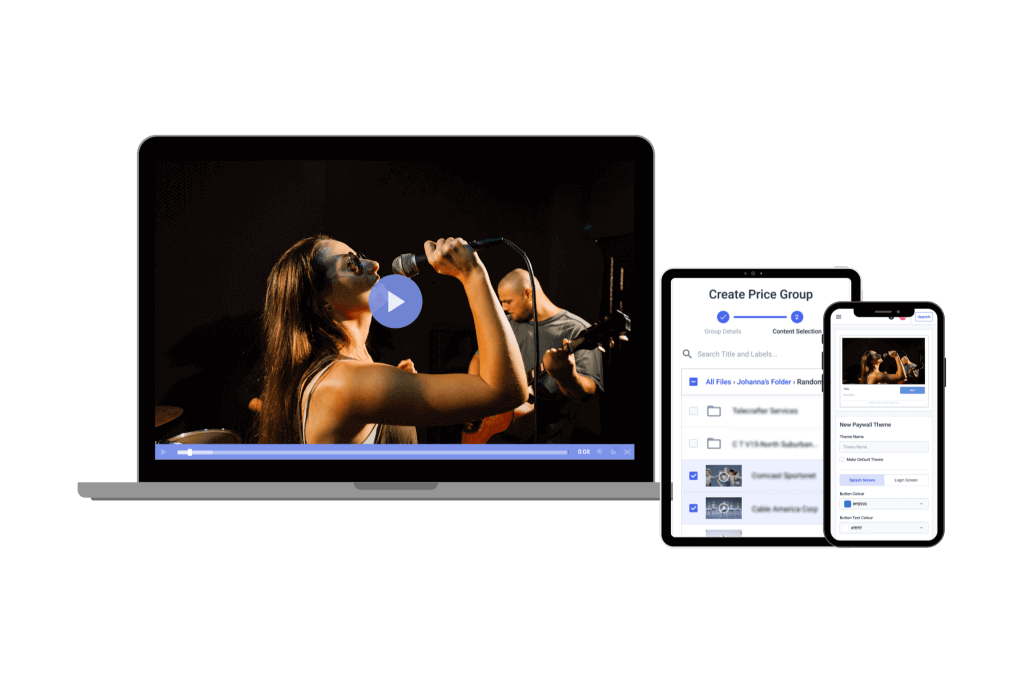
- Monetization: paywall + PPV options for hybrid models
- Delivery: global CDN distribution and playback controls
- Security: access controls like tokenization, domain restrictions, geo-blocking, and password protection
- Operations: analytics to track engagement and stream performance (QoE + business outcomes)
Dacast’s MCP server (Model Context Protocol) connects your streaming stack to AI-ready workflows, so teams can automate stream operations and turn QoE + viewer data into faster decisions.
FAQs
1. What are the biggest OTT trends in 2026?
Hybrid monetization, FAST growth, CTV-first UX, AI-driven personalization, smarter ad measurement, low-latency streaming, and stronger security against piracy and account sharing.
2. How is AI shaping OTT streaming?
AI in OTT streaming enhances personalized recommendations, automated content editing, dynamic ad insertion, and viewer analytics. These technologies improve engagement and retention, making AI a central part of OTT technology innovations, while also influencing how OTT platform features are designed for a smarter, more intuitive viewing experience.
3. What are FAST channels, and why are they growing?
FAST (Free Ad-Supported Streaming TV) channels offer free, linear content supported by ads. Their popularity rises with cost-conscious viewers seeking variety. These channels reflect OTT market trends, deliver value without subscriptions, and demonstrate how OTT trends 2025 are evolving to meet changing consumer habits.
4. How can OTT platforms prevent piracy and account sharing?
OTT platforms protect content with DRM, token-based authentication, and AI-powered monitoring. These strategies prevent unauthorized access, secure revenue streams, and maintain a premium user experience, addressing key over-the-top streaming trends and helping broadcasters stay competitive in a fast-growing market.
5. Which monetization model works best for OTT in 2026?
The best OTT monetization strategies in 2025 combine subscription, ad-supported, and transactional options. These hybrid approaches reflect changing OTT monetization models 2025, maximizing revenue while offering flexibility. Smart platforms adapt to evolving consumer behavior and stay ahead in a crowded OTT landscape.
6. How does Dacast support OTT broadcasters in adapting to these trends?
Dacast provides secure streaming, hybrid monetization tools, low-latency delivery, and analytics that help broadcasters leverage emerging OTT platform features. By integrating key over-the-top streaming trends, Dacast ensures a seamless, profitable experience while supporting innovation and preparing clients for the future of OTT streaming.
7. What’s the difference between FAST and AVOD?
AVOD is on-demand content funded by ads. FAST feels like linear TV: always-on channels with scheduled programming, also funded by ads.
Conclusion: OTT Trends in 2026 and Beyond
When it comes to current OTT trends, the industry is approaching a mature stage. We’re seeing the rise of exciting new OTT technology advancements, along with the consolidation of existing tools. According to the OTT industry forecast, the market is expected to continue growing steadily, with online streaming market predictions highlighting increased adoption of personalized, ad-supported, and FAST services. Broadcasters must also keep an eye on emerging trends in OTT video delivery, including AI-driven recommendations, low-latency streaming, and dynamic monetization strategies.
Creating an OTT streaming service of your own? Try Dacast risk-free for 14 days. Access all the features related to the OTT trends above, including OTT video hosting, video monetization tools, analytics, video management, and much more.
All you have to do to get started with your free trial is create an account on our online video platform. No credit card is required. We’ll have you up and streaming in no time.
If you want to learn more about the video industry, OTT broadcasting, and live broadcasting, feel free to join our LinkedIn group for open conversations about these topics.
We also offer a range of professional services for businesses that need more assistance in getting started. Thanks for reading and, as always, best of luck with your video broadcasts!
