



The Broadcaster’s Guide to CDNs (Content Delivery Networks)

Delivering top-tier online video can be challenging. Content files are getting larger and users expect HD streaming to happen instantly. Broadcasters who value quality are incorporating live streaming CDNs (content delivery networks) to meet this growing demand.
At Dacast, we integrate top-tier CDNs to ensure global delivery and low-latency streaming for our broadcasters. As a CDN-enabled streaming platform, we empower content creators with the infrastructure needed to reach global audiences efficiently and reliably.
In 2026, video file sizes continue to grow due to the widespread adoption of 4K, 8K, and immersive formats, while user expectations for near-instantaneous, buffer-free playback remain at an all-time high. In this highly competitive streaming landscape, low-latency delivery isn’t just a luxury—it’s a necessity. CDNs play a central role in meeting these demands by providing the infrastructure required to deliver high-quality video at scale.
The modern Web is a mixture of text, images, audio, and video with data centers around the world supplying information on a 24/7 basis. However – as the Internet gets more congested – streaming performance suffers and end-users grow frustrated.
To combat this problem, organizations are turning to CDNs to provide greater bandwidth, reliability, and security for their content and websites. Used extensively by social media networks, entertainment companies, e-commerce brands, and enterprise businesses, CDNs quickly (and reliably) serve content to users around the world.
Today, we are going to break down what a CDN is, how they work, and why they matter to broadcasters. We are also going to discuss how content delivery networks improve live streaming/video on demand and enhance the online viewing experience. We will wrap up by comparing a few of the top CDN providers and giving our recommendations for getting started with content delivery networks.
Here’s a little something to think about: over 85% of internet traffic in 2025 is generated by video streaming, highlighting how central CDNs have become to the digital ecosystem. If you plan to share high-quality video content globally, you need a robust and reliable content delivery network. After reading on, you’ll know why.
Table of Contents:
- Why Do CDNs Matter For Broadcasters In 2026?
- What Is A CDN (Content Delivery Network) & How It Works?
- Industry Use Cases
- How Do CDNs Improve Live Streaming?
- Choosing the Right CDN: Why Dacast Integrates with the Best
- Top CDN Networks
- Top Live Streaming CDN Providers
- FAQs
- Conclusion
Why Do CDNs Matter For Broadcasters In 2026?
Content delivery networks (CDNs) offer a wide range of technical advantages for broadcasters, but the benefits go far beyond the backend. Here are a few key examples.
For end-users, enjoying a seamless content delivery experience is the ultimate goal. Audiences want to download information quickly without delays or interruptions. Providing content that can be reliably streamed from any device or location is key for business growth and brand reputation.
Since CDNs store copies of the same media on global servers, a strong connection is always within reach. Response times improve, and user satisfaction remains high.
For website owners, employing multiple servers means less network overhead and reduced costs. Since bandwidth loads are distributed amongst multiple devices, the chances of a system failure are significantly reduced. If one server goes offline, another picks up the slack.
Maintenance costs are lower as well. Organizations don’t need to increase hosting services or buy more powerful servers to meet higher demand. Instead, they can distribute content to additional CDN data centers.
Scalability is never an issue, as extra PoP servers can be added (or removed) as needed.
Content Distribution Networks and Business Growth
A good live streaming platform is essential for growing your brand. Broadcasters must provide clean, robust streaming connections to keep audiences satisfied and generate maximum ROI. This is where CDNs truly shine.
Sharing content from multiple data centers provides a superior user experience.
For example, say you’re in Boston and request a video file from a London server. That data has to travel across the Atlantic Ocean and back to get to you. Even with today’s high-powered transmission cables, there is still latency. However, by adding an additional data center in New York, the transfer delay is significantly reduced.
Studies show that every second of latency reduces website conversions by 7%. Furthermore, nearly 50% of consumers expect a page to load in two seconds or less. Clearly, speed matters. And not just when it comes to visitor satisfaction.
Speed is also a primary ranking factor of SEO (Search Engine Optimization). Site and content assets that load faster see higher conversion stats and lower bounce rates.
Employing CDNs improves available bandwidth and helps deliver content faster.
Speed
The importance of speed for video content delivery simply cannot be overstated. Modern audiences expect a fast web browsing experience and will quickly abandon slow websites. Google reports the chances of visitors abandoning a page increase by 32% with a 1s–3s second delay. That number jumps to 90% as the load time approaches five seconds or more.
When too many users contact the origin server at the same time, performance slows to a crawl. Users get frustrated and websites lose visitors. CDNs minimize these problems by taking the load off the origin server and redistributing it to edge devices.
Reduced latency (delay) results in better video performance and higher quality.
More speed also prevents packet loss – the condition where some data traveling between endpoints is lost (and has to be present). Longer transmission paths, through more equipment with differing hardware and bandwidth speeds, can be a major source of packet loss.
CDNs use the “superhighways” of the Internet to maximize transfer rates.
They are strategically located to shorten distances between hosts and users and employ advanced hardware technology to stream data as quickly as possible with minimal lag or delay.
Reliability
Beyond blazing speed, content delivery networks also increase reliability. Rather than depending on a single server or network, CDNs include redundant data servers all around the world. If one goes down, the rest pick up the slack (and users are none the wiser).
CDNs handle traffic spikes better—whether from malicious attacks or boosts in engagement. When a surge of traffic hits, the load is distributed evenly amongst data centers in the network. This protects the origin (hosting) server and keeps your site running smoothly—even when demand fluctuates.
Depending on the hosting provider and plan you choose, this benefit alone can be a huge differentiator. Smaller hosting vendors cannot handle large traffic surges as well as CDNs because their infrastructure just isn’t built to support it.
CDNs also keep operational costs down since you don’t need to upgrade your hosting plan as your bandwidth needs grow. The CDN throughput expands to match your requirements.
Improved Security
One of the biggest security concerns of delivering content is preventing DDoS (Distributed Denial of Service) attacks. DDoS attacks happen when a website is flooded by millions of fraudulent data requests. This sudden surge of traffic overloads hosting servers and causes them to fail.
CDNs mitigate DDoS attacks by eliminating single points of failure.
With large data centers strategically located around the world, compromising one or two PoP servers does not severely impact the others. Affected computers can be quickly repaired and put back into service—usually before visitors even know.
CDNs also facilitate creating SSL connections between client devices and edge servers, which bolsters network security and helps prevent additional attacks.
Scalability
CDNs are built to handle growing demand. As broadcasters attract more viewers and distribute more content, scaling up is as simple as adding more edge servers or PoPs (Points of Presence). Unlike traditional hosting, there’s no need for expensive infrastructure upgrades. CDNs allow dynamic scaling to accommodate both planned growth and sudden spikes in traffic, making them an ideal solution for broadcasters expanding into new markets or hosting high-traffic live events.
Cost Optimization
Distributing content via CDNs reduces the need for additional hardware, server upgrades, or increased hosting services. By offloading bandwidth and computational requirements from the origin server, broadcasters can lower operational and maintenance costs. This setup enables businesses to pay only for the services they use while still benefiting from premium performance, which is a more efficient allocation of resources than traditional hosting models.
SEO Benefits
Search engine algorithms prioritize page speed and user experience. Since CDNs significantly reduce latency and improve load times, websites using them tend to rank higher in search engine results. Faster loading content also lowers bounce rates and increases visitor engagement—two key metrics that influence SEO performance. By leveraging a CDN, broadcasters not only improve their streaming quality but also gain a competitive edge in digital visibility.
Lastly, world-class tech support is included. Rather than relying solely on internal IT staff, you gain a vendor army to maintain server uptime and reliability—all for a single monthly price with the exact features your business needs.
What Is A CDN (Content Delivery Network) & How It Works?
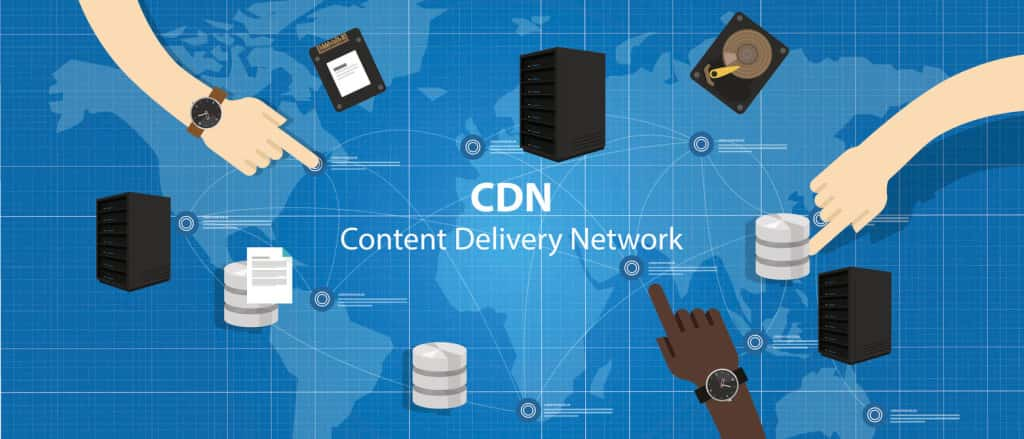
As the name implies, content delivery networks are collections of high-end media servers designed to share files with large audiences. These systems maintain copies of static web files to reduce the load on hosting servers and improve data transfers.
CDNs are computer collections strategically placed in data centers around the world. These synced, mesh content networks provide faster response times and make content delivery more efficient. You may not realize it, but most of us interact with CDNs on a daily basis.
Media and news outlets, e-commerce sites, sports teams, and entertainment brands all use content delivery networks for file delivery. Enterprise organizations like Apple, Microsoft, and Amazon even have their own internal CDNs to manage operations and provide client services.
CDNs can also better accommodate fluctuations in web traffic and minimize the risk of failure from a single system or network. We’ll talk more about that in a moment.
Content delivery networks provide data to users quickly, reliably, and securely. However, the real value lies in the efficiency and scalability they offer to broadcasters.
Organizations can enlarge their digital footprint, serve bigger audiences, and improve user experiences – without requiring major infrastructure upgrades or additional staff.
Normally, clients access content by communicating directly with a video hosting server. Visitors indicate what they want, and the server delivers the goods. While this works fine on a small scale, problems arise as website traffic grows or user locations expand.
Over time, the hosting server starts to bog down (degrading performance). Until eventually – with enough requests – the site falters or crashes.
Even if the server holds up under heavy loads, distance plays a critical role as well.
Most internet data is routed via high-speed fiber optic cable. Although an advanced transmission medium, fiber still has limitations. For every kilometer of distance added, signal delay increases by 3.33 µs. No big deal for local connections—but sending files to the other side of the globe is a different story.
Depending on the total distance covered—and the bandwidth of the remote user—site experiences can differ vastly. This is why CDNs were created.
CDN Streaming Architecture

Rather than relying on a single server or site, content distribution networks employ replication units placed strategically around the globe. These devices are normally found at major IXPs (Internet Exchange Points) between disparate networks. IXPs are locations where ISPs (Internet Service Providers) and CDNs cross into each other.
CDNs utilize both origin servers and edge servers to provide content delivery.
Origin servers – function as the primary source of website data. These are typically the main servers assigned to you by your hosting provider. Although robust machines in their own right, their capacity for serving files is still limited.
Edge Servers – secondary devices strategically located around the globe. Edge servers store “cached” static content from origin servers and mimic their responses to inbound requests.
These devices are also known as PoP (Point of Presence) servers. PoP can also refer to the geographic location where the server resides. Meaning, there may be more than one edge server at each PoP datacenter.
To access content, user requests are first sent to local DNS servers which then forward these inquiries to the nearest edge server. If the data is found, the PoP device delivers the requested media.
If the resource is not found, the request is sent to the origin server. Afterward, the edge server downloads the file and sends it to the user. Eventually, as the edge server continues to cache more content, fewer requests are sent to the origin server.
Thus, reducing the origin server load, minimizing connection latency, and improving video CDN performance.
Complex algorithms use factors such as speed, proximity, and server availability to determine which edge device users connect to. Edge servers also continually “talk” to one another and perform load balancing to ensure user requests are served efficiently and with minimal disruption.
It’s worth noting that CDNs are NOT the same as hosting providers.
Organizations still need to partner with a host platform to set up their website and create file shares. CDN’s simply work in conjunction with video hosting platforms to improve bandwidth, increase security, and help prevent downtime.
2026 CDN Innovations
As the demands of digital broadcasting evolve, so do the technologies behind content delivery networks. In 2026, several innovations are shaping the future of CDN performance, efficiency, and intelligence:
- Multi-CDN Setup: Broadcasters now leverage multiple CDNs simultaneously to ensure optimal performance and uptime. By intelligently routing traffic across different CDN providers, content delivery becomes more resilient and adaptable to global network conditions.
- AI-Based Traffic Routing: Artificial Intelligence is playing a key role in real-time decision-making. AI algorithms analyze factors like traffic patterns, user behavior, and server loads to dynamically route data in the most efficient way possible—improving speed, minimizing latency, and enhancing user experience.
- Predictive Caching: Going beyond traditional caching, predictive caching anticipates which content users will request based on historical data, trends, and location. This allows CDNs to pre-position content at the edge, reducing load times and boosting performance even further.
- Edge Computing: More processing is being offloaded to edge servers, closer to the end user. This reduces back-and-forth communication with central data centers and enables real-time analytics, personalized experiences, and faster streaming—essential for interactive broadcasts and low-latency live video.
- Sustainability Focus: In response to environmental concerns, CDNs in 2026 are optimizing data center energy use and adopting greener infrastructure. Many providers now invest in renewable energy sources and advanced cooling technologies to reduce their carbon footprint, aligning with broader ESG (Environmental, Social, Governance) goals.
These innovations empower broadcasters to deliver faster, smarter, and greener content experiences to global audiences.
Industry Use Cases
While big businesses and CDNs are a natural fit, so are many other verticals and organizations. Education providers can use content delivery networks to share classroom material (video lectures, slide shows, presentations, etc.) with students everywhere. CDNs help educators expand their reach and provide quality experiences to students regardless of their location.
Media and advertising agencies can use CDNs to push content faster and more reliably to larger audiences. Efficiently delivering high-quality content (at scale) is critical for media-based organizations.
Even churches and worship centers can benefit from using content delivery networks to live stream services and create video on demand libraries. CDNs amplify their message and allow these organizations to reach new audiences around the world.
Dacast Real-World Use Cases
1. Cast – Healthcare Webinars & Virtual Events (Education/Healthcare)
- Industry: Healthcare/Professional Education
- Use Case: Cast (Lisbon-based IT and healthcare solutions provider) had used Dacast to deliver webinars and virtual events for audiences ranging from 400 to 4,000 healthcare professionals such as doctors and general practitioners.
- Benefits: They had offered reliable, scalable streaming without the need for credit cards, which had been ideal for managing variable event sizes and effectively using Dacast’s CDN for broad, dependable reach.
2. Television Mobile Resources (Media/Event Production)
- Industry: Media & Event Services
- Use Case: Television Mobile Resources had utilized Dacast for live video streaming with a pay‑as‑you-go model suited to their project-based workflow. The CDN infrastructure had supported large, global audiences.
- Benefits: They had enabled flexible, project-based streaming with global CDN support, eliminating the need for long-term contracts. It had been ideal for clients needing scalable and reliable live video without overcommitting on infrastructure.
3. Christ’s Commission Fellowship (CCF) (Religious/The Nonprofit Sector)
- Industry: Religious & Broadcast CDN Outreach
- Use Case: CCF had broadcast both live and on-demand content via Dacast to audiences in 85 different countries, leveraging Dacast’s CDN to maintain high-quality video delivery regardless of viewer location.
- Benefits: They had delivered consistent high-quality streaming across 85+ countries using CDN infrastructure, enhancing global outreach and supporting mission growth and viewer accessibility.
4. GoggleOutlet.com (E-commerce/Product Marketing)
- Industry: Retail & E‑Commerce
- Use Case: GoggleOutlet.com had used Dacast’s streaming services for live and on-demand video promotions of their sporting gear. Dacast had offered a more flexible and affordable stream hosting solution compared to alternatives.
- Benefits: They had provided a more affordable and customizable live streaming platform, improving customer engagement through product-focused video marketing without high hosting costs.
5. 1545 Media (Video Production & Marketing)
- Industry: Video Production
- Use Case: 1545 Media, an award-winning video production agency, had leveraged Dacast to deliver reliable and cost-effective live video streaming for their clients, enabling high-quality production output tailored to customer needs.
- Benefits: They had delivered professional-grade video streaming services to clients with dependable performance, offering an affordable alternative to larger platforms without sacrificing quality or uptime.
6. Motoraty (Automotive Advisory Content)
- Industry: Automotive Media
- Use Case: Motoraty had delivered expert automotive advice via video to a large audience. They had chosen Dacast for its reliability and competitive pricing.
- Benefits: They had achieved reliable global video delivery with competitive pricing, streamlining distribution of automotive content while maintaining high video quality for a large audience.
7. Seismic Events (Event Streaming Services)
- Industry: Event Services
- Use Case: Seismic Events had partnered with Dacast to deliver dependable live streaming, emphasizing ease of onboarding and steady support.
- Benefits: They had simplified onboarding with fast setup and responsive support, enabling smooth execution of live events with dependable uptime and platform reliability.
8. Digital Execs Recruitment (HR & Recruitment)
- Industry: HR & Recruitment
- Use Case: Digital Execs had used Dacast to power video-based recruitment strategies, valuing cost‑effectiveness and consistency.
- Benefits: They had supported video-centric hiring strategies with consistent reliability, reducing troubleshooting needs and operational overhead through efficient, stable video delivery.
Dacast partners with a top-tier CDN provider, specifically Akamai, to ensure scalable, high-quality live streaming and video-on-demand content delivery worldwide. By early 2025, Dacast has served over 400,000 video producers, including media channels, events companies, educational institutions, sports organizations, government bodies, and religious networks.
How Do CDNs Improve Live Streaming?

Delivering live content to large audiences is tough. Between choosing the right hardware, encoders, and online video solutions, there’s a lot to think about. However, one thing that’s for certain is that fast, reliable, streaming experiences are essential for success.
CDN for live streaming enhances experiences by quickly delivering content (at scale).
Consider this: marketing research finds that 80% of viewers would rather watch live video than read a blog and 82% prefer video to social posts.
67% of online viewers say that quality is the most important aspect of live stream content.
And with good reason – video quality affects our emotions. CDN powerhouse Akamai found that lower quality streaming produced a 14% drop in happiness, an 8% reduction in focus, and 9% increase in disgust. Factors synonymous with higher churn rates, lower lifetime customer value, and fewer ad impressions.
Choosing the Right CDN: Why Dacast Integrates with the Best
When selecting a CDN provider, it’s important to focus on the details. While most have data centers in the major US and European cities, coverage is often lacking elsewhere. Users located outside of these service zones may experience noticeable drop-offs in performance as compared to counterparts elsewhere.
Cost
CDN pricing is always important, but certainly not the only factor. As a broadcaster, you want to look for value rather than just a cheap rate. The best CDNs are affordable but offer enterprise-grade performance for quick downloads and rock-solid security.
Presence
Some content delivery networks use clusters of low-performing servers to reduce costs while others employ fewer PoP units (but with greater capabilities). The actual number of devices also matters as more servers equal higher bandwidth.
You’ll also want to understand where your website traffic is coming from (geographically). Choose a CDN provider with edge servers in close proximity to those areas. Otherwise, video latency will remain an issue.
Features
Learn what makes each provider different from all the rest. Options like live channel provisioning allow you to have as many simultaneous live streams as you want. Some providers limit the total number of streams allowed or charge extra for these options.
Speed and Reliability
Of course, you’ll want to partner with the fastest content delivery networks having the best uptimes. But be sure to evaluate the customer service options as well. Look for providers that offer 24/7 support and robust knowledge bases for clients.
Working with an established, global CDN vendor will typically be your best option.
Top CDN Networks
Once you decide to implement CDNs into your brand, there are two main paths you can follow. The first option is to partner with a dedicated CDN Network. Big names here include Akamai, Cloudflare, and CloudFront (an Amazon Web Services product).
1. Akamai
One of the oldest (and biggest) content delivery networks in existence. The Akamai platform supports both live streaming and video-on-demand hosting and includes security, analytics, and delivery tools. They offer customized pricing based on each customer’s needs.
2. Cloudflare
Cloudflare maintains a global point of presence footprint with features like cloud encoding and customizable video players. Pricing starts at $5 per month (includes first 1,000 minutes of stored video); for Pro or Business plans, they offer 100 free minutes of storage plus 10,000 minutes of delivery per month.
3. CloudFront
A relatively new provider, CloudFront is part of Amazon’s Web Services division. They offer good coverage – and support live streaming/video on demand – but have a somewhat limited feature set. Price is transparent, dynamic and usage-based.
Top Live Streaming CDN Providers
The second option is to work with an online video platform that partners with top-tier CDNs. Popular names here include Wowza, IBM Cloud Video, Vimeo, and Dacast.
1. Wowza
The Stream Cloud product line supports both live streaming and video on demand and includes access to their video API. Wowza offers unique pricing plans for one-off, API, and monthly access. Costs vary but range between $25 to $195 per month.
2. IBM Cloud Video
A seasoned name in the tech world, IBM’s acquisition of Ustream brought video streaming and live hosting into their portfolio. They offer custom branding and an HTML 5 video player with full HD resolution. Pricing ranges between $137 and at $1,299 per month with various feature sets and packages.
3. Vimeo
This live streaming and hosting provider includes native chat and a number of other hardware and software integrations. Costs vary between $20/month up to $83/month depending on the package and feature set you choose.
4. Dacast
A premier live streaming and VOD (video on demand) platform, Dacast CDN integration is a smart choice as we offer 24/7 support, advanced video hosting, video monetization and security options, and some of the lowest pricing in the industry. Most importantly, we deliver content via highly reliable top-tier CDN networks. Pricing starts with the:
- Starter Plan – $39/month – 2,4 TB per year, 500 GB storage
- Event Plan– $63/month – 6 TB upfront, 250 GB storage
- Scale Plan – $165/month – 24 TB per year, 2000 GB storage
With Dacast, you gain access to multiple top-tier CDNs without the complexity of managing them yourself.
For a detailed comparison of these providers, be sure to check out our recent article on video streaming CDN providers.
Top CDN Providers Comparison in 2026
To help you choose the best content delivery network for your streaming needs, here’s a detailed comparison of leading CDN providers highlighting their features, coverage, pricing, live and VOD capabilities, and security options.
| Provider | Features | Coverage & CDN Partners | Cost Ranges (Monthly) | Live Streaming | Video On Demand (VOD) | Security Features |
| Wowza | Live streaming, VOD, API access, adaptive bitrate streaming, DVR, analytics | Global multi-CDN (Akamai, Limelight, etc.) | $25 to $195 | Yes | Yes | SSL/TLS, DRM, Token authentication, IP whitelisting |
| IBM Cloud Video | Live streaming, VOD, custom branding, HTML5 player, cloud transcoding | IBM Global CDN + Ustream integration | $137 to $1,299 | Yes | Yes | SSL/TLS, DRM, Access controls, Geo-restrictions |
| Vimeo | Live streaming, VOD, native chat, player customization, analytics | Global CDN primarily via Akamai | $20 to $83 | Yes | Yes | SSL/TLS, Password protection, Domain-level restrictions |
| Dacast | Live streaming, VOD, monetization, paywall, analytics, 24/7 support | Top-tier global multi-CDN architecture | $39 (Starter) – $165+ | Yes | Yes | SSL/TLS, DRM, Token authentication, Geo-blocking |
Why Top-Tier CDN Access via Dacast Matters
Dacast partners with leading global CDNs—including Akamai and Limelight—to deliver enterprise-grade performance at scale. Here’s how that benefits you:
Global Reach with Low Latency
Stream content to viewers anywhere in the world with minimal buffering and lightning-fast load times.
Unmatched Reliability
Top-tier CDNs provide highly redundant networks, ensuring consistent uptime—even during high-traffic events or peak demand.
Scalability On Demand
Whether you’re streaming to hundreds or millions, Dacast’s CDN-backed infrastructure scales instantly without compromising quality.
Faster Start Times & Playback Stability
Reduced packet loss and efficient content routing mean smoother playback from the very first frame.
Built-In Redundancy and Failover
Accessing multiple CDNs ensures your stream stays up, even if one node goes down.
From a Capterra review, one particularly enthusiastic user shared:
“We don’t broadcast often, but when we do, we need to know that our CDN is solid with little chance of dropping. DaCast has proven their reliability, to us. … We did a week-long broadcast recently, and had zero drops! Those were 12‑hour days and not one drop. That’s amazing.”
— Kent, Owner, Online Media (US)
FAQs
What is the difference between a CDN and a video hosting platform?
A CDN accelerates delivery by distributing video files across global servers, while a video hosting platform manages uploading, organizing, and monetizing. Using both ensures smooth playback, scalability, and audience reach. A solid OTT CDN solution integrates seamlessly with hosting for maximum performance.
How do CDNs improve live streaming for global audiences?
A live stream delivery network reduces latency by routing viewers to nearby servers, ensuring consistent playback, even during peak traffic. This minimizes buffering and improves reliability for worldwide events, relying on strong CDN architecture for global video delivery.
How does Dacast choose which CDN to use?
Dacast evaluates performance, coverage, pricing, and features, selecting the broadcast content delivery network that best matches user needs for quality and global reach. Thorough CDN providers comparison ensures the right fit for every project.
Is a multi-CDN setup necessary for small broadcasters?
For small projects, one edge CDN for streaming is often sufficient. Multi-CDN setups benefit larger broadcasters needing redundancy, scale, and ultra-low latency.
How much bandwidth do I need when using a CDN for live streaming?
Required bandwidth depends on audience size, resolution, and bitrates. The best CDN for video streaming 2026 provides calculators and adaptive bitrate streaming to optimize bandwidth use.
Are CDNs secure for monetized content (pay-per-view, subscription)?
Yes. Secure video delivery with CDN and DRM protects pay-per-view and subscription models, preventing piracy and ensuring only authorized access.
Can CDNs reduce streaming costs?
Yes, intelligent routing and scaling allow CDN cost optimization for streaming events, lowering expenses by delivering efficiently while maintaining quality.
Which CDN is ideal for live sports events?
The best CDN for live sports streaming in 2026 provides ultra-low latency, high concurrency support, and seamless global coverage, ensuring fans experience real-time action without delays.
How do AI tools enhance CDN performance?
AI-driven CDN optimization for video predicts traffic patterns, balances loads, and automates routing, resulting in smoother playback and fewer buffering interruptions.
Do CDNs help with video quality?
Yes, how CDNs improve video quality and reduce buffering is through edge caching and adaptive bitrate streaming, delivering sharp visuals consistently.
What role do CDNs play in OTT distribution?
A CDN for OTT and FAST channel distribution supports scalable delivery for streaming services, ensuring high-quality playback across connected TVs, apps, and devices.
Are there sustainable options for video streaming CDNs?
Yes, sustainable CDN providers for broadcasters use energy-efficient infrastructure and renewable energy to reduce carbon impact while maintaining reliable video delivery.
Conclusion
One of the best ways to access top-tier CDNs for live streaming is to partner with an online video platform like Dacast. Our integration provides top-notch reliability and speed for your content while keeping operating costs and complexity to a minimum.
Dacast offers a number of value-added features such as an integrated CMS (Content Management system), robust user analytics, advanced monetization options, and open SDKs/APIs to build your own custom apps.
Dacast provides the tools to use and enhance your video and the CDN handles the rest.
If you’re ready to add a top-tier CDN provider to your live streaming and VOD library, check out Dacast’s 14-day free trial (no credit card required). Enjoy full streaming platform access with no strings attached. Just click the button below to get started.
Thanks for reading. If you have any questions or experiences to share, please let us know in the comments. And for regular tips on live streaming, join our LinkedIn group.
