



Comparing The 10 Best Video CDN Providers for Live Streaming in 2026

By Dacast Editorial Team | Reviewed by Jon Whitehead, COO at Dacast | Updated August 2026
Selecting the right video CDN in 2026 is one of the fastest ways to improve startup time, buffering, reliability, and global reach, without changing your cameras or production workflow.
A modern live streaming stack usually looks like this:
- Ingest (contribution): RTMP or SRT from encoder → cloud
- Packaging: HLS (often CMAF) into adaptive bitrate renditions
- Delivery (distribution): CDN edge servers deliver segments close to viewers
- Player: HTML5 video player on web + mobile
The “best” CDN depends on your priorities: global scale, low latency, security, China delivery, analytics, or cost control.
In this post, we’re going to look into all things related to video CDNs. We will compare 10 video streaming CDN providers for mobile-compatible, HTML5 live video streaming. We will also look at four online video platforms with built-in content delivery networks or powerful CDN partners.
TL;DR:
- If you need maximum global scale + proven live streaming reliability, start with Akamai.
- If you want developer-friendly edge control + real-time performance, look at Fastly or Cloudflare.
- If you’re all-in on a cloud ecosystem, pair the cloud CDN with its media tooling: AWS CloudFront, Google Cloud CDN/Media CDN, or Azure CDN/Front Door.
- If you want a simpler “CDN + streaming platform” bundle, an OVP like Dacast / Vimeo / Wowza / IBM Video Streaming can be faster to deploy than stitching tools together.
Table of Contents:
- What is HTML5 Live Video Streaming?
- What is a Video Content Delivery Network (CDN)?
- How Do Video CDNs Work?
- What Is the Difference Between CDN and Caching?
- Why Use a Video Streaming CDN?
- Content Delivery Networks and Video Hosting
- AI-Driven Video Delivery Networks and CDNs
- What to Look for in a Video CDN
- Multi-CDN Strategies for Live Streaming
- The 10 Best Video CDN Providers for 2026
- Top 4 Online Video Platforms with Integrated CDNs
- FAQs
- Conclusion
What is HTML5 Live Video Streaming?
HTML5 live video streaming means your stream plays in modern browsers without plugins, using the browser’s native video capabilities and standards-based delivery.
Today, most professional workflows look like:
- Ingest (contribution): RTMP or SRT from encoder/OBS → platform/cloud
- Packaging + playback: HLS (often CMAF) to an HTML5 video player for broad device support
- Delivery at scale: a video CDN ensures viewers are served from nearby edge locations (instead of a single origin server)
HTML5 delivery matters because it supports mobile-first viewing, embedded playback, and secure, controlled distribution on your own website (not just social platforms).
What is a Video Content Delivery Network (CDN)?
A video content delivery network (CDN) is a network of geographically distributed servers that deliver video segments and assets to viewers from the closest edge location.
Video is heavy: it uses far more bandwidth than typical web pages. A CDN for live streaming helps prevent:
- buffering during traffic spikes
- overloaded origin servers
- poor performance for viewers far from your origin region
In 2026, CDNs increasingly add intelligent routing, edge compute options, and integrated security because video delivery is now a core business workload, not a “nice to have.
How Do Video CDNs Work?
The internet may seem instantaneous, but there’s always some delay when content travels across networks. CDN live streaming technology minimizes this delay by caching video files on multiple geographically distributed live streaming servers. This process ensures that users receive content from the nearest available server rather than a distant origin server.
With the distribution of video content across a global network of servers, media CDNs help to reduce buffering, decrease bandwidth costs, and provide a smoother streaming experience for users. Leveraging a high-performance video CDN is crucial for delivering high-quality video at scale for any enterprise, OTT platform, or independent creator.
Now, let’s take a look at some of the key advancements in streaming CDNs:
- Ultra-Low Latency Streaming: Leveraging WebRTC and AI-driven traffic routing, modern CDNs can now deliver live video with sub-second latency, which is critical for real-time events and interactive streaming.
- Edge Computing & AI-Powered Optimization: CDNs now use edge servers to process and optimize video closer to the viewer, reducing congestion and improving performance. AI-driven algorithms analyze traffic patterns to adjust content delivery dynamically.
- Multi-CDN & Hybrid Streaming Strategies: Many businesses are adopting a multi-CDN approach, combining multiple providers to enhance reliability, mitigate outages, and improve load balancing.
- 5G & Adaptive Bitrate Streaming (ABR): As 5G adoption grows, CDNs are optimizing scalable video streaming to support higher resolutions, such as 4K and 8K, while ABR ensures seamless playback based on a viewer’s network conditions.
- Security Enhancements: Leading video delivery networks now integrate DDoS protection, token authentication, and DRM (Digital Rights Management) to safeguard content and prevent unauthorized access.
What Is the Difference Between CDN and Caching?
Caching = storing content closer to where it’s requested to reduce repeated trips to the origin.
- Browser/device caching stores files locally (good for static web assets, not enough for large-scale live video).
- A CDN is caching at scale, across many edge locations worldwide, so millions of viewers can pull content locally from a nearby server.
In other words:
- caching is the concept
- a CDN is the infrastructure + routing + scale layer built around that concept
CDNs and caching are essential technologies for managing high volumes of data requests, preventing slowdowns, and ensuring a seamless user experience. These technologies help balance digital supply and demand, regardless of whether you are streaming live video or hosting large-scale web applications.
Why Use a Video Streaming CDN?
A video streaming CDN helps you deliver a better viewer experience and a more reliable business outcome:
- Cost Efficiency & Bandwidth Optimization: AI-driven CDNs intelligently manage resources, reducing redundant data transfers and lowering streaming costs for businesses. This is especially valuable for platforms offering high-quality, long-form video content.
- AI Video Compression & Encoding: AI-driven encoding technologies analyze real-time bandwidth conditions and optimize bitrate dynamically, delivering higher-quality video with lower data usage. This is crucial for high-resolution formats like 4K, 8K, and VR streaming.
- Ultra-Low Latency Streaming: AI-powered routing dynamically selects the fastest paths between the origin server and end-users, significantly reducing delays. This is essential for real-time events, gaming, and interactive streaming.
- Scalable Video Streaming: AI-driven CDNs automatically adapt to traffic fluctuations, handling millions of concurrent viewers without performance drops. OTT CDNs and Media CDNs now integrate with edge AI to process and cache content closer to users, improving playback speed.
- Enhanced Security: AI-based threat detection identifies and mitigates cyber threats like DDoS attacks, credential stuffing, and piracy attempts. AI-powered encryption and watermarking ensure content protection for broadcasters.
Content Delivery Networks and Video Hosting
Every time you visit a website or stream a video online, a server processes your request and delivers the content to your device. A video CDN consists of thousands of these servers distributed worldwide, ensuring fast, reliable video transmission. The better the streaming CDN, the higher the video quality, reducing buffering and latency for users.
For businesses, AI-driven CDNs are transforming video delivery networks by:
- Predicting traffic surges and pre-caching popular video segments to prevent congestion.
- Dynamically optimizing video quality based on real-time network conditions using AI-powered adaptive bitrate streaming.
- Enhancing security by detecting and mitigating cyber threats, including DDoS attacks and video piracy.
Beyond delivery, AI-powered video hosting platforms are also evolving. Free platforms like YouTube offer basic hosting, but businesses require a more professional private video platform. They need dedicated, scalable video streaming solutions that provide robust server infrastructure and AI-enhanced encoding for superior playback performance.
AI-Driven Video Delivery Networks and CDNs
A video delivery network (VDN) is a specialized CDN designed for scalable video streaming. It caches, compresses, and optimizes video delivery across multiple servers, reducing latency and buffering and ensuring high-quality playback.
The best CND providers use VDN technology to effectively deliver video content across different regions. A CDN video hosting solution ensures that video data is stored and delivered in a way that maximizes performance, especially high-traffic events like live streams. The largest CDN providers, such as Akamai, offer great video hosting CDNs capable of handling large volumes of traffic while minimizing interruptions.
For live streaming, a live stream CDN further optimizes video delivery by using adaptive bitrate streaming and low-latency protocols. These ensure viewers experience minimal lag and quality drops. Whether for video hosting or live streaming, the best CDN for video streaming improves the user experience through reliable, high-speed access to video content, especially during peak traffic times.
Today’s CDN providers are leveraging AI and machine learning to enhance video streaming performance, especially in live streaming scenarios. Using AI-powered Video CDNs, businesses can scale video distribution efficiently while improving quality, security, and viewer experience. The future of media CDN technology lies in intelligent automation, ensuring flawless video streaming optimization at any scale.
What to Look for in a Video CDN Provider
Before we go deeper into our platform comparison, here’s a key tip: Some platforms focus solely on content delivery networks (CDNs), while others are Online Video Platforms (OVPs) that provide both hosting and streaming solutions. Understanding the differences will help you choose the best fit for your needs.
When selecting a dedicated video CDN, ensure it has a large, reliable network of globally distributed servers. The best CDN for video streaming should offer:
- High-speed content delivery with minimal buffering
- Low-latency streaming for real-time engagement
- Scalable bandwidth to accommodate audience growth
A robust streaming CDN is especially important if you’re reaching a global audience or streaming in high resolutions (4K/8K).
What Is an Online Video Platform (OVP)?
An OVP is a specialized online video platform designed for video hosting, management, and streaming. Many platforms support live streaming and offer built-in content delivery via integrated video CDN providers. While smaller than all-purpose CDNs, they often provide affordable, feature-rich solutions for businesses.
An OVP allows you to do many things:
- Upload and manage video-on-demand content
- Stream live video with built-in encoding and delivery
- Organize files via an online dashboard
- Optimize content for mobile, desktop, smart TVs, and any other devices
- Use custom video players
- Embed on a website or any social media platform of your choice
- Monetize over-the-top video via methods like pay-per-view or subscriptions
- Restrict access to content using security settings
- Include custom branding on video content
When choosing a video streaming solution, look for a video platform that partners with top CDN providers. These will likely provide your users the highest quality on-demand videos and the biggest bang for your buck in terms of additional features for the price.
Multi-CDN Strategies for Live Streaming
Leveraging multiple CDNs in a Multi-CDN setup helps enhance the reliability and performance of video streaming by distributing content across several networks. This strategy ensures that if one CDN experiences issues, others can seamlessly take over, minimizing downtime and buffering.
Geographically distributed servers achieve low latency streaming, improving viewer experience globally. Multi-CDN configurations also enhance scalability, making it easier to handle traffic spikes and ensuring consistent performance for large-scale live streaming events and OTT streaming services.
The 10 Best Video CDN Providers for 2026
Below is a comparison of the 10 best CDNs for video hosting and live streaming. We’ll discuss each company’s history, what features they offer, and their CDN pricing comparison. That way, you can choose the best CDN for your needs.
Comparison snapshot :
| Provider | Best for | Notable strengths |
|---|---|---|
| Akamai | Enterprise live events | massive edge scale, security + delivery |
| Fastly | Developer-first edge delivery | real-time controls + edge compute |
| Cloudflare | Security + performance bundle | global network footprint + security stack |
| KeyCDN | Simple + cost-effective delivery | straightforward setup, smaller footprint |
| Amazon CloudFront | AWS-native scale | huge PoP footprint + AWS integrations |
| Google Cloud CDN | Google Cloud workloads | 100+ cache locations + cloud tooling |
| Leaseweb | Multi-CDN managed approach | multi-CDN orchestration + 400+ PoPs access |
| CDN77 | Video-focused delivery | strong performance focus + streaming features |
| Microsoft Azure CDN | Microsoft stack | Azure integration + pay-as-you-go pricing |
| Sucuri | Security-first CDN for sites | WAF + malware response + CDN speed layer |
1. Akamai
Best for: global enterprise live streaming, large-scale events
Akamai is one of the longest-running CDN providers and remains a top choice for high-scale media delivery and enterprise-grade security, with a global network of over 4,100 PoPs.
Standout strengths
– Enterprise-grade delivery and security
– Massive global reach for international audiences
– Strong ecosystem for complex media workflows
AI & Edge capabilities (2026)
– Distributed AI inferencing at the edge to reduce latency
– Advanced edge computing for real-time processing and personalization
Pricing
Typically custom and sales-led, especially for video-heavy or enterprise use cases.
2. Fastly
Best for: low-latency delivery, real-time control, developer-led stacks
Fastly is a high-performance video CDN known for real-time cache control, edge programmability, and tooling that’s popular with engineering teams optimizing CDN live streaming and media delivery.
Standout strengths
- Real-time purge and fine-grained cache controls
- Strong edge compute for custom workflows
- Observability and logging built for live operations
AI & Edge capabilities (2026)
- Edge compute for real-time request logic (auth, routing, personalization)
- Automated performance insights and anomaly signals (platform-dependent)
Pricing
Usage-based tiers with enterprise options for high-volume video streaming CDN needs.
3. Cloudflare
Best for: security + performance at global scale (especially web + video together)
Cloudflare is a widely adopted video content delivery network (CDN) option for organizations that want strong edge performance paired with DDoS/WAF security, plus flexible developer tooling.
Standout strengths
- Strong security stack (DDoS, WAF, bot mitigation)
- Broad global footprint + smart routing options
- Developer platform (Workers) for edge logic
AI & Edge capabilities (2026)
- Edge logic for token validation, access control, dynamic routing
- Automated traffic insights and performance optimizations (varies by product)
Pricing
Tiered plans (business/enterprise for advanced features); video-specific products priced separately.
4. KeyCDN
Best for: simple, cost-effective CDN delivery for smaller teams
KeyCDN is a straightforward CDN for live streaming and web assets when you want predictable setup and simple pay-as-you-go delivery, often used for smaller-scale media workflows.
Standout strengths
- Simple configuration and management
- Clear pricing model for bandwidth-based delivery
- Solid baseline CDN caching and delivery features
AI & Edge capabilities (2026)
- Practical edge routing/caching controls (not marketed as “AI-first”)
- Best used when you want simplicity over advanced orchestration
Pricing
Pay-as-you-go with region-based rates; good fit for lighter media CDN workloads.
5. Amazon CloudFront
Best for: AWS-native live streaming at scale (MediaLive/MediaPackage workflows)
Amazon CloudFront is AWS’s global video CDN provider, commonly used for CDN video hosting architectures and large event distribution when paired with AWS media services.
Standout strengths
- Deep AWS integration (S3, Media services, security tooling)
- Strong global delivery footprint for large audiences
- Mature tooling for enterprise deployment patterns
AI & Edge capabilities (2026)
- Edge compute (Lambda@Edge / CloudFront Functions) for real-time request handling
- Integration paths to analytics/automation across the AWS ecosystem
Pricing
Pay-as-you-go, region-dependent; enterprise discounts available with commits.
6. Google Cloud CDN
Best for: Google Cloud stacks and global delivery using Google’s edge network
Google Cloud CDN (and Media CDN for media-heavy workloads) is a strong video streaming CDN option for organizations already built on GCP and needing scalable distribution.
Standout strengths
- Strong routing/load balancing options
- Fits well with GCP infrastructure and security patterns
- Good choice for global web + video delivery architectures
AI & Edge capabilities (2026)
- Edge-enabled routing and delivery optimization (platform-driven automation)
- Integration paths for analytics and workload automation within GCP
Pricing
Usage-based across egress, cache fill, and requests; volume discounts for large usage.
7. Leaseweb
Best for: managed multi-CDN strategies and failover for critical events
Leaseweb offers CDN services including multi-CDN approaches that can improve reliability for live streaming CDN use cases where uptime and redundancy matter.
Standout strengths
- Multi-CDN routing options for resilience and performance
- Managed approach (helpful if you don’t want to build steering yourself)
- Flexible deployment for regional/global delivery needs
AI & Edge capabilities (2026)
- Traffic steering and routing logic (automation varies by plan)
- Edge-based controls to support failover and routing decisions
Pricing
Custom quotes are common, based on regions, traffic, and SLA requirements.
8. CDN77
Best for: video-focused delivery with strong throughput and performance tuning
CDN77 is a video CDN used for VOD and live distribution by teams that want performance-oriented delivery and streamlined control for media workloads.
Standout strengths
- Media-friendly delivery focus
- Strong performance tuning and delivery features
- Useful for both live and on-demand distribution
AI & Edge capabilities (2026)
- Delivery optimization and traffic control (varies by product)
- Edge caching strategies designed for media throughput and stability
Pricing
Transparent plans with enterprise options for high-volume and SLA needs.
9. Microsoft Azure CDN
Best for: Microsoft/Azure ecosystems and enterprise procurement environments
Azure CDN (often paired with Front Door) supports scalable video CDN delivery for organizations that standardize on Microsoft cloud infrastructure.
Standout strengths
- Native Azure integration + enterprise-friendly deployment models
- Security and routing options through Azure networking stack
- Scales well for global distribution and spikes
AI & Edge capabilities (2026)
- Edge routing, acceleration, and policy-driven delivery via Azure stack
- Automation potential via Azure monitoring and rules-based systems
Pricing
Pay-as-you-go with region-based bandwidth tiers; enterprise agreements common.
10. Sucuri
Best for: security-first CDN needs (WAF + protection + CDN acceleration)
Sucuri is best viewed as a website security platform with CDN acceleration. It can fit CDN for live streaming scenarios where site security and protection are the primary requirement.
Standout strengths
- Strong WAF and security posture for sites
- DDoS mitigation and monitoring focus
- Simple packaged plans compared to enterprise CDNs
AI & Edge capabilities (2026)
- Threat detection/mitigation workflows (security-first automation)
- Edge filtering rules and policy enforcement (varies by plan)
Pricing
Packaged annual plans; enterprise/custom pricing for multi-site needs.
Top 4 Online Video Platforms with Integrated CDNs
Now, it’s time to review a few of the top online video platforms with integrated video content delivery networks. When you need a video content distribution network and a video CDN network, it can be great to work with a service provider that can give you both simultaneously.
1. Dacast

To kick off this review of CDN providers and OVPs, we will start by examining our own video hosting and streaming platform.
Basic Functionality:
All video content hosted on Dacast is delivered via top-tier CDNs from Akamai & CloudFront. Our streaming solution includes various security features, offers 24/7 customer support, and an easy-to-use online video platform. This can be acquired through every plan level.
Dacast also uses an HTML5 video player to provide you with better performance, which you can customize to your own needs.
Detailed Features:
- Secure, global content delivery, including industry-best video hosting
- 24/7 tech support with all plans, including email and live chat
- Video security features, including password-protected hosting and AES encryption
- VOD platform to monetize on-demand content, and to scale your VOD business
- Expo video gallery to display your live streams in an immersive video showcase
- RTMP Encoder for ingesting HLS streaming
- SRT ingest
- Low latency HTML5 channels for video streaming
- Player API access for 3rd party player integration
- Video API access on premium plans (event and scale)
- Multi-bitrate streaming for live video and VOD
- Cloud video transcoding with true adaptive bitrate streaming (ABR)
- Live encoding support for the top video encoders
- Real-time video streaming analytics
- Ad-free streaming
- M3U8 file creation capability to enable adaptive streaming delivery of OTT video content across various devices
- Fully integrated RTMP streaming platform features
- Advanced API to build your own video CMS
- AES video encryption for advanced streaming security
- Multi-user access (MUA) on Scale and Custom plans
- Zoom live streaming integration for meetings and live events in real-time
- Expo galleries video portal for immersive video experiences
- Authenticate-only paywall for no payment content gating
- Plays by Location geographical insight
- Chinese streaming platform support
- Digital Rights Management (DRM) for VOD
- Multi-CDN streaming for high-quality broadcasts
- Browser-based live streaming with WebRTC
- MCP server
Pros:
- Live streaming and VOD packages on all plans
- Unlimited viewers and live channels
- White label and branding control
- Embeddable HTML5 video player
- SVOD, AVOD, and pay-per-view TVOD monetization options
- Mobile device support
- Live stream recording
- China Video Hosting
- Plans for every budget
Cons:
- Takes a little bit of time to learn all of the features
Pricing:
Dacast offers different plans for broadcasters with different needs. The video streaming pricing plans include:
- Starter: $39/month billed annually (includes 2.4 TB bandwidth and 500 GB storage)
- Event: $63/month billed annually (includes 6 TB bandwidth and 250 GB storage)
- Scale: $165/month billed annually (includes 24 TB bandwidth and 2 TB storage)
- Custom: contact sales for custom pricing plans
Read more here about live streaming pricing plans in more detail.
If you need a video hosting platform where you can customize the video player to fit your needs with an integrated CDN hosting service, Dacast is the way to go. Dacast also offers a multi-CDN feature, the type of CDN you need for live video streaming.
2. IBM Video Streaming

IBM Video Streaming is a comprehensive SaaS platform designed for live broadcasts and on-demand video content, enabling organizations to reach audiences through open or password-protected channels or by embedding streams on other websites.
As of 2026, the platform integrates advanced AI capabilities powered by IBM Watson®, enhancing functionalities such as automated closed captioning and content search.
Basic Functionality:
Key features of the IBM Video Streaming platform include custom branding on higher-priced plans, password-protected hosting, and an HTML5 video player. The service also includes HD broadcasting up to 720p resolution with full 1080 supported only on Enterprise plans.
Key Features:
- Live and On-Demand Streaming: Broadcast live events or provide on-demand access to recorded content.
- Simulated Live Streaming: Schedule pre-recorded videos to stream as live events.
- Auto-Archiving: Automatically archive live streams for future access.
- Security and Privacy: Offers secure sharing options, including password protection and detailed access controls, ensuring content privacy.
- Video Monetization: Implement strategies to generate revenue from your video content.
- Enterprise Content Delivery Network (eCDN): Ensure efficient and secure video delivery within corporate networks.
- AI-Powered Features: Use IBM Watson® AI for automated closed captioning and deep video search capabilities.
Pros:
- One of the best-streaming cloud storage set-ups with reliable cloud streaming
- Responsive customer support
- Enterprise-grade video capabilities for large organizations
- Hong Kong (China) video hosting
- Impressive analytics feature where you can monitor various KPIs of live-streaming
- Easily upload video files and media for your audience during the live broadcast
Cons:
- Uses an internal content delivery system
- General plans don’t offer APIs
- The chat feature isn’t the best, given that this supports a large audience
- Users report issues with data synchronization and upload during heavy traffic
Pricing:
The pricing plans for the IBM Cloud Video include:
- Start Trial – Video Streaming: Give it a free test drive for 30 days
- Silver: Affordable Essentials, 100 viewer hours, 5 channels, 1 TB video storage, starting at $145/month
- Gold: Standard business features, 2,000 viewer hours, 10 channels, 2 TB video storage, starting at $729/month
- Platinum: Premium Volume scale, 5,000 viewer hours, 20 channels, 5 TB video storage, starting at $1,460/month
- Custom: Please contact IBM Cloud video for custom plan pricing as well as payment plans
With it’s enhanced CDN solutions, IBM Video Streaming is a great platform for live streaming content for your business.
3. Vimeo
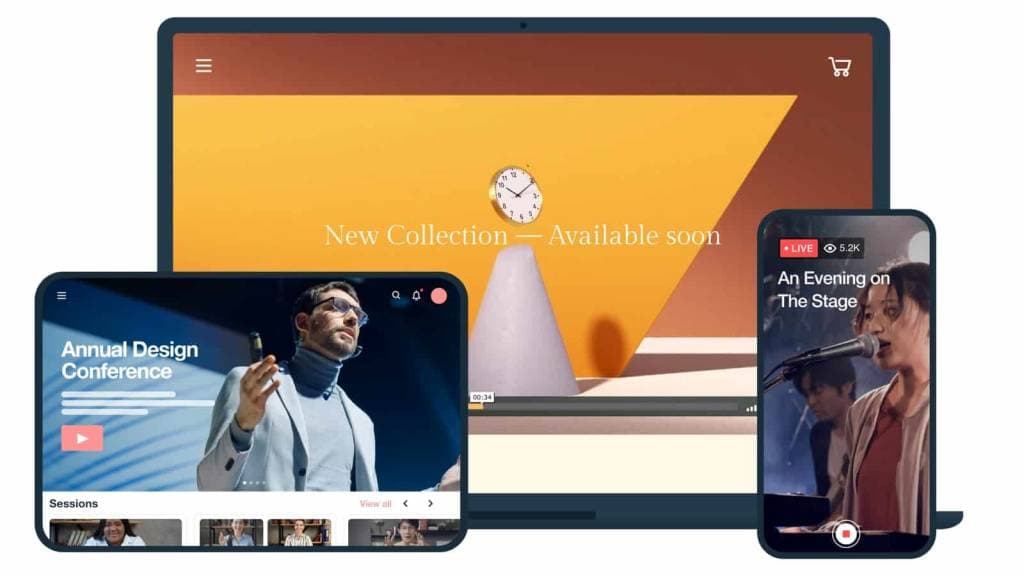
Vimeo is a comprehensive video platform that empowers creators and businesses to host, stream, and manage high-quality videos. Focusing on delivering ad-free content, Vimeo offers a suite of tools for video creation, editing, live streaming, and monetization. It caters to a diverse range of users, from individual creators to large enterprises.
Basic Functionality:
Vimeo provides robust solutions for on-demand video hosting and live streaming. Users can upload videos in up to 4K Ultra HD, ensuring exceptional visual quality. The platform’s customizable video player allows seamless embedding across various websites while maintaining brand consistency. Additionally, Vimeo offers advanced privacy settings, enabling users to effectively control access to their content.
Key Features:
- Hosting and Player: Ad-free hosting with a customizable player that supports 4K Ultra HD playback.
- Monetization: Options for creators to earn revenue through subscriptions, pay-per-view, and on-demand video sales.
- Creation and Editing: Built-in tools for recording, editing, and enhancing videos, including AI-powered features for automated editing.
- Security and Compliance: Advanced security measures, including single sign-on (SSO), domain whitelisting, and compliance tools to protect content.
- Live Streaming and Events: Capabilities for live streaming events, webinars, and virtual conferences with interactive features like live chat and Q&A sessions.
- Video Management: Organize and secure video content with a centralized library, collaboration tools, and detailed analytics.
- Analytics: In-depth insights into viewer engagement, geographic data, and performance metrics to inform content strategy.
Pros:
- Ad-Free experience
- Comprehensive toolset
- High-quality streaming
- Extensive integration
- Strong privacy controls
Cons:
- Steep learning curve
- Cost considerations
Pricing:
Vimeo offers basic video hosting plans that are suitable for content creators and startups. These include:
- Free: $0/month; 1 GB storage, creation and editing, screen recording
- Starter: $20/month; 100 GB storage, auto closed captioning, custom URLs and video player, privacy tools
- Standard: $41/month; 1 TB storage, engagement and social analytics, AI script generator, teleprompter, brand kit
- Advanced: $108/month; 5 TB storage, stream to multiple destinations, host live broadcasts and webinars, AI-generated chapters and text summaries
- Enterprise: Custom pricing; more storage and bandwidth, advanced AI capabilities, quality events, dedicated support
Vimeo is great if you want to maximize the usage of your content by turning your live streams into VOD content.
4. Wowza

Wowza provides a range of powerful streaming solutions tailored to various businesses. With its global reach, Wowza focuses on both live streaming and on-demand video hosting through its Wowza Video Cloud and Wowza Streaming Engine. It delivers scalable, high-quality streaming services that integrate with third-party tools, APIs, and a video content management system.
Basic Functionality:
Wowza offers its Wowza Streaming Engine for self-hosted video workflows in addition to Wowza Video, which is a comprehensive streaming and integrated video solution.
Wowza allows broadcasters to build highly customized streaming workflows using third-party integrations, APIs, and other advanced features.
Key Features:
- Multi-bitrate Streaming: Deliver adaptive video streams with varying qualities to ensure smooth playback across different devices and network conditions.
- Secure Streaming: Utilize DRM protection and encryption for secure delivery of video content.
- Live and On-Demand Streaming: Stream live events or offer video-on-demand (VOD) content with robust support.
- Global CDN: Achieve worldwide content delivery for minimal latency and optimal performance.
- API Integration: Integrate seamlessly with third-party services and custom workflows.
Pros:
- Strong security
- Cross-device compatibility
- Live streaming and video-on-demand
- Global CDN for reliable delivery
- Connects with Google Analytics
- China video delivery
- Scalable solutions for high-volume needs
Cons:
- Requires third-party integrations for monetization
- Pricing can be higher for custom enterprise solutions
Pricing:
Wowza offers two main tiers: Video Cloud and Streaming Engine.
1. Wowza Video Cloud Streaming offers three different pricing plans:
- One Month of Streaming: $149 one-time purchase; includes 15 hours of live streaming and 500 viewing hours
- Pay as you go: $0/month; $2.50/hour of streaming, all usage billed separately
- Enterprise: Annual plans built for your needs; contact sales for custom pricing
All of these Live Event plans include full brand control, adaptive-bitrate streaming, and HD and UHD streaming.
2. Wowza Streaming Engine has its own pricing plans. These professional-grade streaming plans are billed annually and include:
- One Month of Streaming: $295 one-time purchase + $295month for each additional instance
- Basic Monthly: $195/month + $195/month for each additional instance
- Enterprise: Please contact Wowza directly for access to their custom-tailored high-volume enterprise solutions
FAQs
1. What CDN does Dacast use for live streaming?
Dacast delivers all video content through Akamai, one of the world’s largest CDN providers with over 4,100 Points of Presence globally. This ensures low-latency delivery, high availability during traffic spikes, and reliable performance for live events and VOD content worldwide.
2. What is the difference between a CDN and an OVP?
A CDN (Content Delivery Network) is infrastructure, it distributes video segments from edge servers close to viewers. An OVP (Online Video Platform) is a complete solution that includes hosting, encoding, a video player, monetization tools, and CDN delivery bundled together. If you need just delivery at scale, a dedicated CDN is the choice. If you need an end-to-end streaming stack without assembling components yourself, an OVP with an integrated CDN like Dacast is faster to deploy.
3. What is CDN media?
A media CDN is a type of video content delivery network optimized for delivering video, audio, and images with minimal latency. It ensures content is available globally with fast delivery speeds, improving the overall experience of scalable video streaming.
4. Which CDN services are best for video streaming?
Some of the best CDNs for video streaming include Akamai, Cloudflare, CloudFront, Google Cloud CDN, and Microsoft Azure CDN. These providers offer features like low latency streaming and reliable performance for live streaming CDN services.
5. What is CDN vs DNS?
A CDN is a network of servers distributing content across multiple locations for faster delivery, while DNS (Domain Name System) maps domain names to IP addresses, ensuring users access the correct content through the video delivery network or streaming CDN.
Conclusion
In 2026, a great live stream isn’t just about cameras and bitrate—it’s about delivery. The right video CDN improves startup time, buffering rates, reliability during spikes, and global reach.
- Choose an enterprise CDN if you need maximum scale and deep security.
- Choose a cloud CDN if you want tight integration with your infrastructure.
- Choose an OVP with an integrated CDN if you want the fastest path to a reliable, professional live streaming stack.
Interested in testing out a powerful live streaming solution today? We recommend taking advantage of the Dacast free trial. With 14 days of free access (no credit card required), you can test out nearly every Dacast feature. Just click the button below to sign up and give it a try today.
You can try Dacast and all its features right now for free.
